
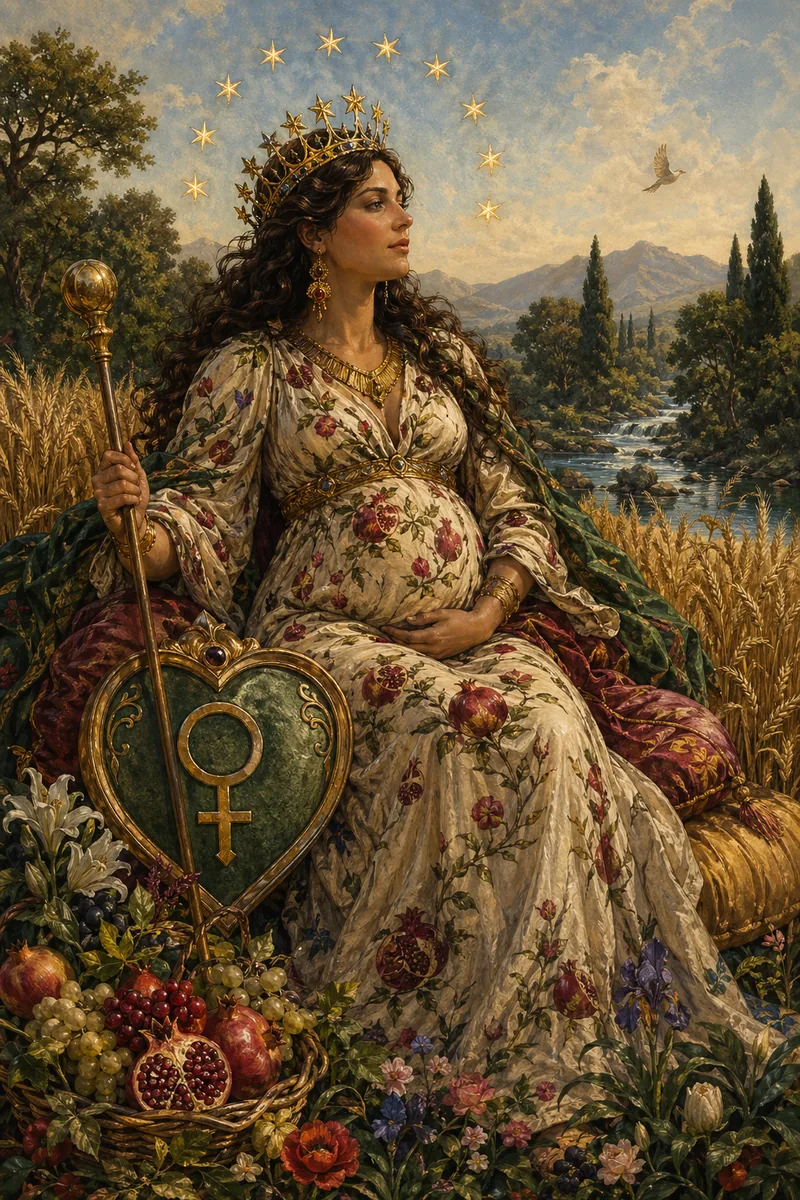
Major Arcana · 3
The Empress
L'Impératrice · L'Imperatrice · Mother Nature
The The Empress tarot card meaning runs through both orientations: upright, abundance, fertility, creativity; reversed, creative block, smothering, neglect. Below, its imagery across the Rider–Waite–Smith, Thoth, and Marseille decks, and what the tradition’s writers said about it.
- Element
- Earth
- Planet
- Venus
- Hebrew
- Daleth
- Numerology
- 3
- Timing
- Late spring through summer; Taurus and Libra seasons; full bloom phases.
Upright
- abundance
- fertility
- creativity
- nurturance
- sensuality
- Mother Nature
Reversed
- creative block
- smothering
- neglect
- dependence
- disconnection from body
The Empress Tarot Card Meaning
Upright
Abundance is the natural state — and you are aligning with it. The Empress is creative power expressed through the body, the senses, the earth. Whatever you tend now will grow. Slow down enough to enjoy what is already ripening. Pleasure is not a distraction from your purpose; it is your purpose.
- Love
- Deep, embodied love. Sensuality without performance. For couples, romantic abundance and possibly literal fertility. For singles, you are magnetic now — but the magnetism comes from self-love, not seeking. Pregnancy can be literal or symbolic.
- Career
- Creative projects flourish. Roles involving design, art, beauty, hospitality, gardening, food, healing, motherhood, mentorship are all favored. Your work environment matters — a beautiful space supports a productive mind.
- Finances
- Steady abundance. Money flows when tied to what you genuinely love and value. Investments in beauty, real estate, art, or land are favored.
- Health
- Vitality, fertility, sensual aliveness. Eat well, sleep well, touch the earth. For those trying to conceive, an encouraging card. Pay attention to the womb space — physical or metaphorical.
- Spiritual
- The sacred is in the body. Earth-based practice, immanent rather than transcendent. Pleasure as devotion. The divine feminine made flesh.
Reversed
Either smothering nurturance or its opposite — creative block, disconnection from the body, neglect of self. The Empress reversed asks: who are you mothering at the cost of your own care? Or, where have you stopped tending the garden of your own life?
- Love
- Codependence, smother-love, or martyr-mothering. Loss of self in relationship. For singles, attempting to attract through self-abandonment. Love must include the lover.
- Career
- Creative block. Burnout from over-giving. Imposter feelings around beauty or aesthetic work. Step back from the project; tend yourself first.
- Finances
- Overspending on beauty or comfort to soothe inner emptiness. Or, scarcity mindset that refuses pleasure. Find the middle: nourishment without excess.
- Health
- Reproductive health needs attention. Disordered eating. Disconnection from the body's signals. Touch starvation. Reground in slow, embodied care.
- Spiritual
- Bypassing the body for 'higher' realms. Or worshipping aesthetics as substitute for depth. Mother Nature is not an image — she is your skin.
Those are the card’s meanings in general. A reading tests them against the question the querent actually asked — the person asking is what makes one drawing of The Empress differ from the next.
The image, three ways
Rider–Waite–Smith
A woman crowned with twelve stars sits upon cushions in a field of golden wheat. A heart-shaped shield bearing the symbol of Venus rests beside her. A river flows through a forest behind her; she wears a robe patterned with pomegranates.
Thoth
A pregnant goddess figure holding a scepter topped with a lotus, surrounded by birds, fish, and the spiraling forms of life. The card pulses with biological abundance.
Marseille
L'Impératrice — seated, crowned, holding a scepter and shield with an eagle. More regal and less natural than later versions; the medieval mind imagined abundance through nobility.
Four ways a reversal speaks
After Mary K. Greer, Tarot Reversals (2002)
01 · excessive
Smother-mother energy; care that consumes the cared-for; nurture used as control.
02 · blocked
Creative drought; the womb-space empty; pleasure refused as discipline.
03 · denied
The body's pleasures refused on principle; sensuality treated as suspect.
04 · opposite
Sterility where there should be fertility; the garden ungated and untended.
What the tradition says
The tradition broadly agrees that the Empress represents fertility and generative power rooted in the physical world. Crowley, Pollack, Nichols, and Greer all read her as the body's own intelligence — the principle that produces, nourishes, and sustains through sensory, earthly life rather than through will or intellect.
Where the readings differ: Waite reads abundance as potentially obscuring clarity and introduces doubt and difficulty where Pollack, Nichols, and Greer emphasize direct, embodied vitality — though Nichols alone adds a cautionary shadow, warning that the same maternal force that nourishes is capable of engulfing.
A.E. Waite · 1910
The Pictorial Key to the Tarot
Fruitfulness, action, initiative, the unknown, clandestine; also difficulty, doubt, ignorance. Waite is ambivalent about her — abundance can also obscure clarity.
Aleister Crowley · 1944
The Book of Thoth
The Empress as Venus — the most universally beneficent of all the planets. She is the salt of the alchemists, the fertility of all worlds.
Rachel Pollack · 1980
Seventy-Eight Degrees of Wisdom
The Empress represents the natural world experienced as alive and sacred — not Mother Nature as a metaphor but as direct perception.
Sallie Nichols · 1980
Jung and Tarot: An Archetypal Journey
The Empress is the Great Mother in her benevolent aspect — the ground of being that produces without effort because production is her nature. Nichols warns that she shares a face with the Devouring Mother; the same fertility that nourishes can engulf.
Mary K. Greer · 1984
Tarot for Your Self
Greer asks the Empress querent to walk through their home, their wardrobe, their plate — the actual sensory life — and locate where they have starved themselves of pleasure under cover of discipline. The body's hungers are the card's intelligence.
Shadow
The smothering mother; the woman whose worth depends on what she produces or whom she nurtures; aesthetic spirituality without substance.
Archetypal role
The Great Mother / The Creatrix / Earth Goddess / Lover-Queen
Historical notes
The Empress and the Emperor are paired since the Visconti-Sforza decks; their ordering occasionally swaps in different traditions. Crowley placed her on path 14, connecting Wisdom (Chokmah) and Understanding (Binah) — making her the path along which divine masculine and feminine principles meet.
The Empress: common questions
- Is The Empress a yes or no card?
- In a yes-or-no reading, The Empress leans yes.
- What do tarot writers agree The Empress means?
- The tradition broadly agrees that the Empress represents fertility and generative power rooted in the physical world. Crowley, Pollack, Nichols, and Greer all read her as the body's own intelligence — the principle that produces, nourishes, and sustains through sensory, earthly life rather than through will or intellect.
- What does The Empress tarot card mean?
- Abundance is the natural state — and you are aligning with it. The Empress is creative power expressed through the body, the senses, the earth. Whatever you tend now will grow. Slow down enough to enjoy what is already ripening. Pleasure is not a distraction from your purpose; it is your purpose.
- What does The Empress mean in love?
- Deep, embodied love. Sensuality without performance. For couples, romantic abundance and possibly literal fertility. For singles, you are magnetic now — but the magnetism comes from self-love, not seeking. Pregnancy can be literal or symbolic.
- What does The Empress mean for career and money?
- Creative projects flourish. Roles involving design, art, beauty, hospitality, gardening, food, healing, motherhood, mentorship are all favored. Your work environment matters — a beautiful space supports a productive mind.
- What does The Empress reversed mean?
- Either smothering nurturance or its opposite — creative block, disconnection from the body, neglect of self. The Empress reversed asks: who are you mothering at the cost of your own care? Or, where have you stopped tending the garden of your own life?
Neighbouring arcana
The Empress combinations
Last reviewed 2026-06-18
Keep learning
Bring this card into a question
Begin a reading