
Major Arcana · 4
The Emperor
L'Empereur · L'Imperatore
The The Emperor tarot card meaning runs through both orientations: upright, authority, structure, stability; reversed, tyranny, rigidity, control. Below, its imagery across the Rider–Waite–Smith, Thoth, and Marseille decks, and what the tradition’s writers said about it.
- Element
- Fire
- Planet
- Mars
- Zodiac
- Aries
- Hebrew
- Heh
- Numerology
- 4
- Timing
- Aries season (late March–April); within a quarter; Tuesdays (Mars day).
Upright
- authority
- structure
- stability
- fatherhood
- leadership
- discipline
Reversed
- tyranny
- rigidity
- control
- abuse of power
- lack of structure
The Emperor Tarot Card Meaning
Upright
Build the structure. The Emperor is the conscious imposition of order on chaos — the wisdom of boundaries, the dignity of follow-through. This is a card of authority earned, not borrowed. Take responsibility for your domain. Plan, decide, commit.
- Love
- A stable, committed partnership. Or attraction to someone steady, reliable, mature. For couples, this can mean engagement, marriage, or a deepening of structural commitment. For singles, embody the qualities you want to attract.
- Career
- Leadership, promotion, taking the reins. Roles involving administration, executive function, military, government, family business. If you've been waiting for permission to lead — stop. Claim the chair.
- Finances
- Strong financial foundations. Long-term planning, investments, real estate, retirement accounts. Build the infrastructure of wealth. Boring money decisions are the right money decisions.
- Health
- Discipline serves the body now. Routine, structure, strength training. Watch for stress on the cardiovascular system from overwork. Don't skip recovery.
- Spiritual
- The discipline of practice. Spiritual maturity through structure — daily ritual, lineage, commitment. Faith without form scatters; form without faith hardens. The Emperor holds both.
Reversed
Either rigid control or its absence — chaos from no structure. Tyranny in micro form. Examine where you're using rules to avoid feeling, or where you're refusing necessary structure because of authority wounds. The Emperor reversed often signals father issues coming up for healing.
- Love
- Controlling partner, or yourself becoming controlling. Patriarchal patterns running the relationship. For singles, attraction to unavailable men or to authority figures. Examine the imprint.
- Career
- Boss who micromanages, toxic top-down culture, abuse of power. Or your own resistance to any authority blocking advancement. Find the middle: respect competence; refuse cruelty.
- Finances
- Rigid budgeting that strangles life, or financial recklessness from refusing structure. Bureaucratic obstacles. Tax issues.
- Health
- Hypertension, stress-related cardiovascular issues, jaw clenching, type-A burnout. Or the opposite — body neglected because all structure has collapsed.
- Spiritual
- Religious authoritarianism. Or rejection of all structure leading to spiritual drift. The shadow father. Heal the lineage.
Those are the card’s meanings in general. A reading tests them against the question the querent actually asked — the person asking is what makes one drawing of The Emperor differ from the next.
The image, three ways
Rider–Waite–Smith
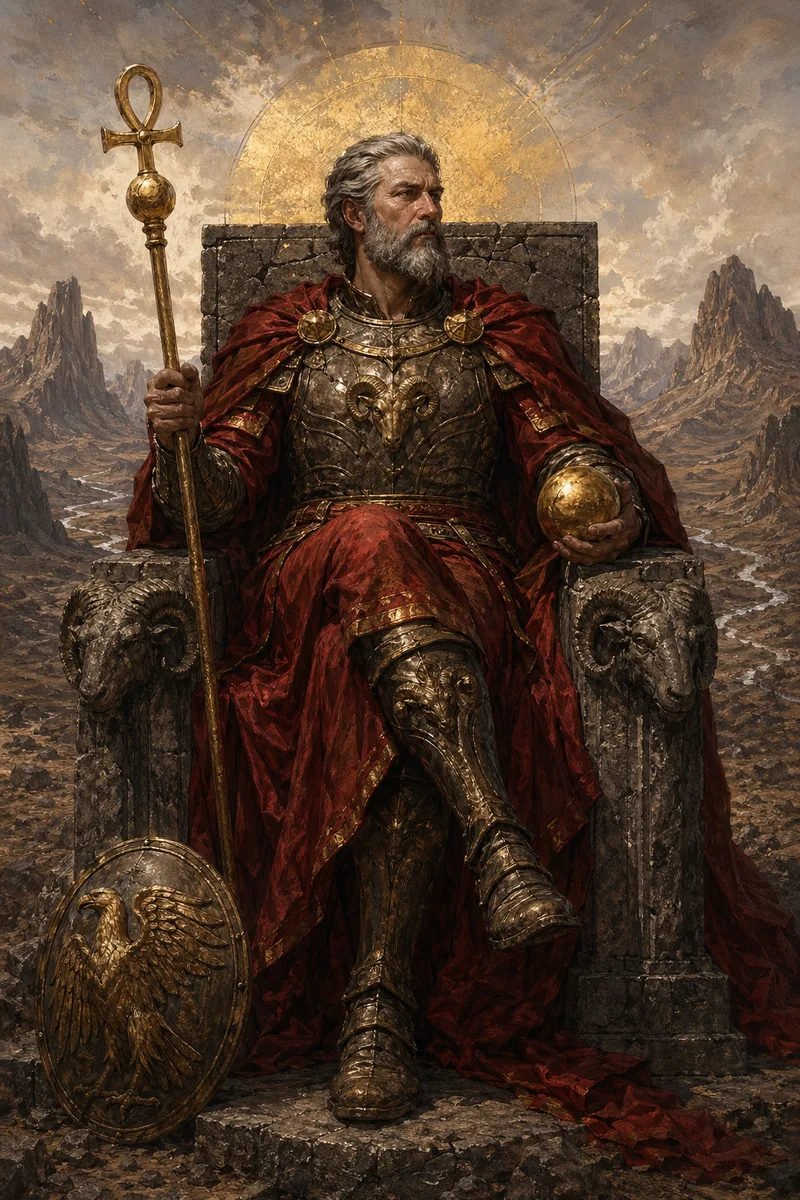
A bearded patriarch sits on a stone throne carved with ram's heads. He wears armor beneath red robes, holds an ankh-topped scepter and a golden orb. Barren mountains rise behind him; a thin river snakes at the base.
Thoth
An armored king on a throne of fire and lambs. The card emphasizes Aries energy — initiative, drive, kingship as living flame.
Marseille
L'Empereur — seated in profile, legs crossed in a 4-position, holding a scepter, eagle shield at his side. The crossed legs form the figure 4 — the geometry of stability.
Four ways a reversal speaks
After Mary K. Greer, Tarot Reversals (2002)
01 · excessive
Tyranny; rules as weapon; structure imposed past where it serves.
02 · shadow
The patriarchal abuser; authority weaponized; the cold father.
03 · opposite
Chaos for lack of structure; refusing all authority including one's own.
04 · karmic
Inherited father-wound; generational patterns of authoritarian harm reaching for healing.
What the tradition says
The tradition broadly agrees that the Emperor stands for conscious authority, structured order, and the willingness to take responsibility. Waite grounds this in stability and realized power; Pollack, Nichols, and Greer each build on the same foundation — that the Emperor's value lies in his capacity to hold form, protect what matters, and act with conviction.
Where the readings differ: Crowley reads the Emperor as pioneering Aries-fire who breaks new ground, where Greer reframes him as the seeker's reclaimed self-authority rather than an external model of power, and Nichols adds a cautionary shadow dimension — rigidity and over-identification with one's own structure — that the others largely leave unaddressed.
A.E. Waite · 1910
The Pictorial Key to the Tarot
Stability, power, protection, realization, conviction; reason, conviction, also authority and will.
Aleister Crowley · 1944
The Book of Thoth
Aries — the originating fire of will. Crowley emphasizes the Emperor's pioneering, ram-like initiative; he is the one who breaks new ground.
Rachel Pollack · 1980
Seventy-Eight Degrees of Wisdom
The Emperor represents the structure that makes the abundance of the Empress sustainable; without him, fertility scatters.
Sallie Nichols · 1980
Jung and Tarot: An Archetypal Journey
The Emperor is the animus in its constructive form — the inner masculine that builds, defends, and decides. Nichols reads his stone throne as the petrified father-complex when held too long; the Emperor's shadow is the man who has become his own armor.
Mary K. Greer · 1984
Tarot for Your Self
Greer reframes the Emperor for women and others raised under patriarchy as the recovery of one's own authority — the Emperor reversed in the seeker's life is exactly the point of healing. To draw him upright is to inhabit one's own throne.
Shadow
The tyrant; the cold father; the man who confuses domination with leadership; the patriarch who weaponizes order against feeling.
Archetypal role
The King / The Father / The Builder / The Sovereign
Historical notes
The Emperor and Empress pair since the earliest decks. Some early Italian decks had a 'Popess' and 'Pope' instead, with imperial figures separate. The figure 4 — both his number and the way his legs cross in many depictions — encodes the stability the card represents.
The Emperor: common questions
- Is The Emperor a yes or no card?
- In a yes-or-no reading, The Emperor leans yes.
- What do tarot writers agree The Emperor means?
- The tradition broadly agrees that the Emperor stands for conscious authority, structured order, and the willingness to take responsibility. Waite grounds this in stability and realized power; Pollack, Nichols, and Greer each build on the same foundation — that the Emperor's value lies in his capacity to hold form, protect what matters, and act with…
- What does The Emperor tarot card mean?
- Build the structure. The Emperor is the conscious imposition of order on chaos — the wisdom of boundaries, the dignity of follow-through. This is a card of authority earned, not borrowed. Take responsibility for your domain. Plan, decide, commit.
- What does The Emperor mean in love?
- A stable, committed partnership. Or attraction to someone steady, reliable, mature. For couples, this can mean engagement, marriage, or a deepening of structural commitment. For singles, embody the qualities you want to attract.
- What does The Emperor mean for career and money?
- Leadership, promotion, taking the reins. Roles involving administration, executive function, military, government, family business. If you've been waiting for permission to lead — stop. Claim the chair.
- What does The Emperor reversed mean?
- Either rigid control or its absence — chaos from no structure. Tyranny in micro form. Examine where you're using rules to avoid feeling, or where you're refusing necessary structure because of authority wounds. The Emperor reversed often signals father issues coming up for healing.
Neighbouring arcana
The Emperor combinations
Last reviewed 2026-06-18
Keep learning
Bring this card into a question
Begin a reading