
Major Arcana · 5
The Hierophant
The Pope · Le Pape · Il Papa · The High Priest
The The Hierophant tarot card meaning runs through both orientations: upright, tradition, spiritual wisdom, education; reversed, dogma, rebellion, unconventional path. Below, its imagery across the Rider–Waite–Smith, Thoth, and Marseille decks, and what the tradition’s writers said about it.
- Element
- Earth
- Planet
- Venus
- Zodiac
- Taurus
- Hebrew
- Vau
- Numerology
- 5
- Timing
- Taurus season (April–May); within a season; Friday (Venus day).
Upright
- tradition
- spiritual wisdom
- education
- convention
- lineage
- marriage
Reversed
- dogma
- rebellion
- unconventional path
- personal beliefs
- challenged tradition
The Hierophant Tarot Card Meaning
Upright
Honor what has been transmitted. The Hierophant represents knowledge passed through lineage — religious, spiritual, philosophical, professional. Sometimes the path forward is the established one. A teacher, mentor, or institution has something genuine to offer. Tradition is not the enemy of authenticity.
- Love
- Marriage, traditional commitment, formal partnership. Meeting through religious or community channels. For couples, deepening through shared values or ritual. The 'right' relationship in the conventional sense.
- Career
- Institutional roles, education, religious vocation, law, academia, established corporations. Mentorship — find a mentor or become one. Credentialing matters now; the formal path opens doors.
- Finances
- Conservative financial planning. Established institutions over speculative ventures. Inheritance, family money, traditional investments. Not the time for crypto or crowdfunding gambles.
- Health
- Conventional medicine; trusted practitioners; second opinions from credentialed sources. Throat and neck (Taurus rules these); thyroid attention.
- Spiritual
- Lineage, initiation, formal study. The teacher who teaches because they were taught. Religious practice — even if you've left, revisit what was given to you. There may be gold in your inheritance you discarded too quickly.
Reversed
Question the dogma. The Hierophant reversed challenges inherited belief — the path that doesn't fit, the rules that no longer serve. This is the moment of becoming your own authority. But beware the simple inversion: rejecting tradition wholesale is its own form of conformity.
- Love
- Unconventional relationship structure, or rejection of marriage norms. Or, the relationship is failing because it's only a performance of tradition with no inner reality. Find authentic form.
- Career
- Leaving the institution, going freelance, breaking from family expectations. Whistleblowing. Or, conversely, an authority figure has lost legitimacy and you must navigate that.
- Finances
- Refusing the family financial script. Unconventional income. Or, debts inherited from following someone else's plan.
- Health
- Seeking alternative or holistic medicine after conventional fails. Or healing requires breaking with family health patterns and beliefs.
- Spiritual
- The deconstruction phase. Leaving the religion. Spiritual but not religious. Eventually, building your own practice — but this requires more discipline, not less, than inherited form.
Those are the card’s meanings in general. A reading tests them against the question the querent actually asked — the person asking is what makes one drawing of The Hierophant differ from the next.
The image, three ways
Rider–Waite–Smith
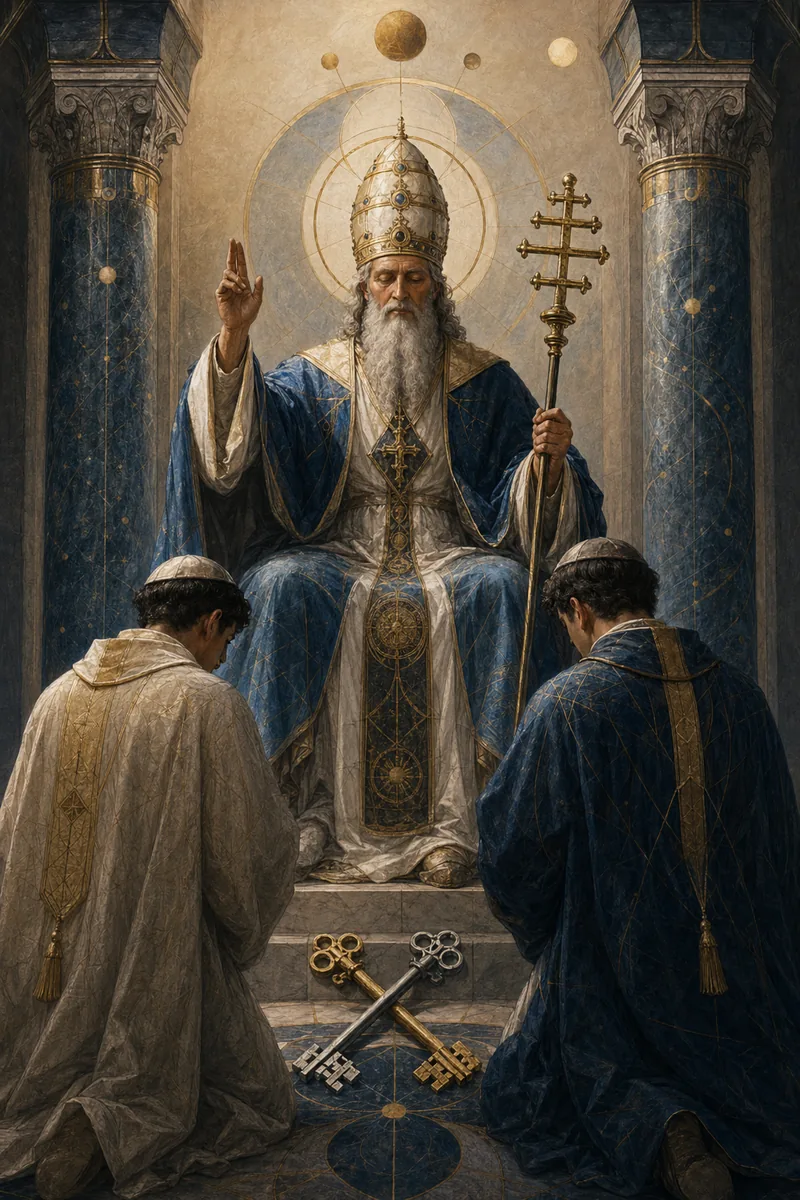
A robed pope-figure raises one hand in blessing, the other holding a triple-crossed staff. Two acolytes kneel before him; crossed keys lie at his feet. Two pillars frame him.
Thoth
A horned, masculine hierophant within a hexagram, surrounded by elephantine figures and a dancing female form. Crowley reinterprets the card through the lens of the Aeon of Horus — the priest as sacred sexual initiator.
Marseille
Le Pape — seated between two pillars, blessing two tonsured monks who kneel before him. More clearly papal than later esoteric versions.
Four ways a reversal speaks
After Mary K. Greer, Tarot Reversals (2002)
01 · opposite
Rebellion against tradition; rejecting the inherited because it's inherited, not because it failed examination.
02 · shadow
Religious abuse; institutional harm hidden under sanctity.
03 · karmic
Inherited belief systems running uninspected; the religion of one's parents still operating.
04 · blocked
Stuck dogma; the form continued past the spirit's interest.
What the tradition says
The tradition consistently reads the Hierophant as a figure of transmitted knowledge — the carrier of something received, tested, and passed on. Most readers agree the card concerns the relationship between individual seekers and established systems of meaning, whether religious, philosophical, or communal, and asks how we stand in relation to what we have inherited.
Where the readings differ: Waite frames the card as the outer face of divine revelation through institution, Crowley anchors it in Taurean persistence and priestly mystery, Pollack emphasizes the communal re-binding function of religion itself, Greer stresses the personal reckoning with unchosen belief, and Snow shifts the card entirely toward the deliberate construction of chosen lineage outside harmful inherited frameworks.
A.E. Waite · 1910
The Pictorial Key to the Tarot
Marriage, alliance, captivity, servitude; mercy and goodness; inspiration. Waite stresses the Hierophant as the outer face of revelation.
Aleister Crowley · 1944
The Book of Thoth
Crowley reinterprets the Hierophant in Taurean terms — strength, persistence, the bull of heaven; he frames the card around the New Aeon's mystery of the priest.
Rachel Pollack · 1980
Seventy-Eight Degrees of Wisdom
The Hierophant is the bridge between divine truth and human community — religion in its etymological sense, 're-binding' the individual to the whole.
Mary K. Greer · 1984
Tarot for Your Self
Greer reads the Hierophant as the moment of asking: who taught you what you believe, and have you ever genuinely chosen those teachers? Sometimes the upright Hierophant means returning to a tradition; sometimes it means finally finding a teacher whose wisdom you recognize as yours.
Cassandra Snow · 2019
Queering the Tarot
Snow reads the Hierophant as the inherited religious framework that often does damage to queer and trans seekers, and reframes the upright card as the act of building one's own lineage — chosen mentors, queer elders, found tradition. The card stops being conformity and becomes intentional belonging.
Shadow
The dogmatist; the religious abuser of authority; the credentialist who confuses certification with wisdom; the rebel who is still defined by what they reject.
Archetypal role
The Teacher / The Pope / The Initiator / The Lineage Holder
Historical notes
The card was originally Il Papa (the Pope) in Italian decks. As tarot moved into Protestant lands, it became 'The Hierophant' — a more neutral term derived from Greek for 'one who reveals sacred things,' the title of the chief priest at the Eleusinian Mysteries. Crowley fully transformed the card under his Aeon-of-Horus framework.
The Hierophant: common questions
- Is The Hierophant a yes or no card?
- In a yes-or-no reading, The Hierophant leans yes.
- What do tarot writers agree The Hierophant means?
- The tradition consistently reads the Hierophant as a figure of transmitted knowledge — the carrier of something received, tested, and passed on. Most readers agree the card concerns the relationship between individual seekers and established systems of meaning, whether religious, philosophical, or communal, and asks how we stand in relation to what we have inherited.
- What does The Hierophant tarot card mean?
- Honor what has been transmitted. The Hierophant represents knowledge passed through lineage — religious, spiritual, philosophical, professional. Sometimes the path forward is the established one. A teacher, mentor, or institution has something genuine to offer. Tradition is not the enemy of authenticity.
- What does The Hierophant mean in love?
- Marriage, traditional commitment, formal partnership. Meeting through religious or community channels. For couples, deepening through shared values or ritual. The 'right' relationship in the conventional sense.
- What does The Hierophant mean for career and money?
- Institutional roles, education, religious vocation, law, academia, established corporations. Mentorship — find a mentor or become one. Credentialing matters now; the formal path opens doors.
- What does The Hierophant reversed mean?
- Question the dogma. The Hierophant reversed challenges inherited belief — the path that doesn't fit, the rules that no longer serve. This is the moment of becoming your own authority. But beware the simple inversion: rejecting tradition wholesale is its own form of conformity.
Neighbouring arcana
The Hierophant combinations
Last reviewed 2026-06-18
Keep learning
Bring this card into a question
Begin a reading