


The reading
The relief you feel when you imagine leaving — you asked whether that counts as an answer. The cards are telling you to look more carefully at what the question is actually made of, because relief is not simple, and this spread is not going to let you use it as one.
The Eight of Cups stands in the Past position, and it is one of the most precise cards in the deck for what you are describing. In the Rider-Waite-Smith image, a figure walks away at night — not in anger, not in drama, but in quiet, deliberate departure — leaving eight cups stacked behind them, still whole, still full enough. The cups are not broken. The relationship is not villainous. The Eight of Cups is the card of "this isn't enough anymore," which is harder to act on than "this is wrong," because it gives you nothing to point at. You can't make a case with it. You just feel the absence of something that should be there and isn't, and you start walking. The fact that this card is in the Past position tells me this is not a new feeling. You have already been in the Eight of Cups for a while — the walking-away has been happening inside you before it became a question you were willing to say out loud. The soul-search preceded this reading. The cards are not introducing it; they are confirming it arrived.
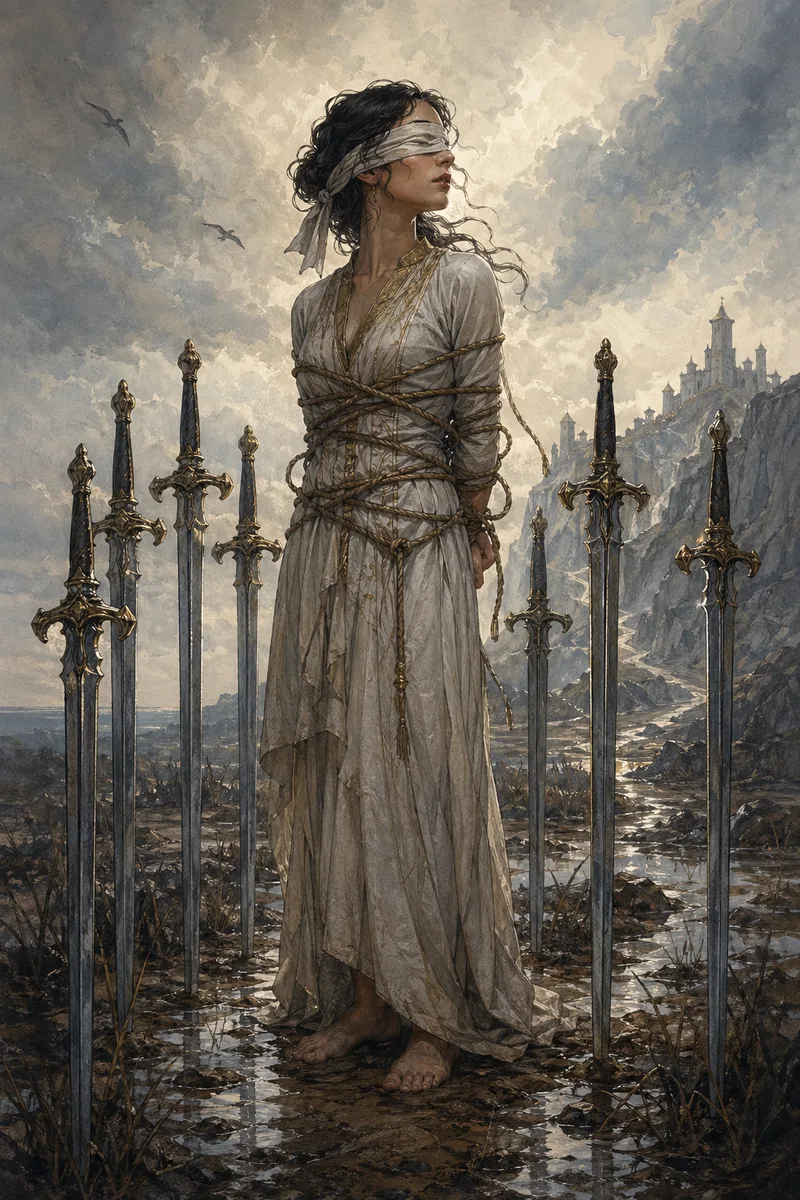
But here is where the spread earns its difficulty: the Present is the Eight of Swords reversed, and this card is both the most important card on the table and the most uncomfortable one to sit with. Upright, the Eight of Swords shows a figure blindfolded and loosely bound, surrounded by swords that are not actually piercing her — the ropes are slack, the escape route exists, she simply cannot see it. Reversed, that image shifts in a specific direction, and I want to be precise here: the reversal is not "she escapes cleanly." The modes that fit this card in this position are the mental prison maintained from inside — the warden and the prisoner being the same person — alongside the possibility that the bonds are visibly loosening, that the realization of possible escape is arriving, but also the risk that the old trap-story re-establishes itself once partial recognition fades. What that means for your question is this: some of what is holding you is real, and some of it is the story you have been telling about what is holding you, and the reversed Eight of Swords cannot tell you which is which. It can only tell you that the distinction matters and that right now, in this moment, you are the one with the blindfold.
There is a shadow the engine surfaced with this card that I won't skip past: the chronic victim, the one whose suffering has become identity. I am not saying that is you. I am saying the card flagged it, and a good reading honors the flag. Ask yourself honestly: has the story of this relationship, and of your difficulty leaving it, become something that organizes your sense of yourself? Is there a version of you, on the other side of this decision, who would no longer know what to lead with when someone asks how you are? The Eight of Swords reversed doesn't indict you for that — it's a deeply human thing, and the trap is subtle — but it is asking you to look at whether the relief you feel when you imagine leaving is relief from him, or relief from the role.
Now, the absence of Wands in this spread. Not a single fire card. No will, no desire, no forward thrust, no sexuality, no the-thing-that-makes-you-reach-across-the-bed-at-two-in-the-morning. That absence is not neutral. In a love reading about whether to stay or go, the fire being missing entirely is information: whatever is keeping you in this question, it is not passion. It is not that the fire is complicated or conflicted — it simply did not show up. You are in a Water-Air-Earth conversation: emotional history, mental story, material stability. The body's wanting, the spirit's forward-pull — those are not in the room.
The two Eights in this spread — the Eight of Cups in the Past, the Eight of Swords in the Present — belong together, and the numerology is precise here. Eights are movement and mastery, the energy that has already moved through reflection and now demands action with all its accumulated complexity. The spread is running two Eights in a row into a Four, and that arc is the story: movement, movement, stillness. The Eight of Cups is the movement that already happened internally. The Eight of Swords reversed is the movement that is trying to happen and keeps getting blocked, or internalized, or re-wound. And the Four of Pentacles is what the spread is warning you the trajectory builds toward if nothing shifts.
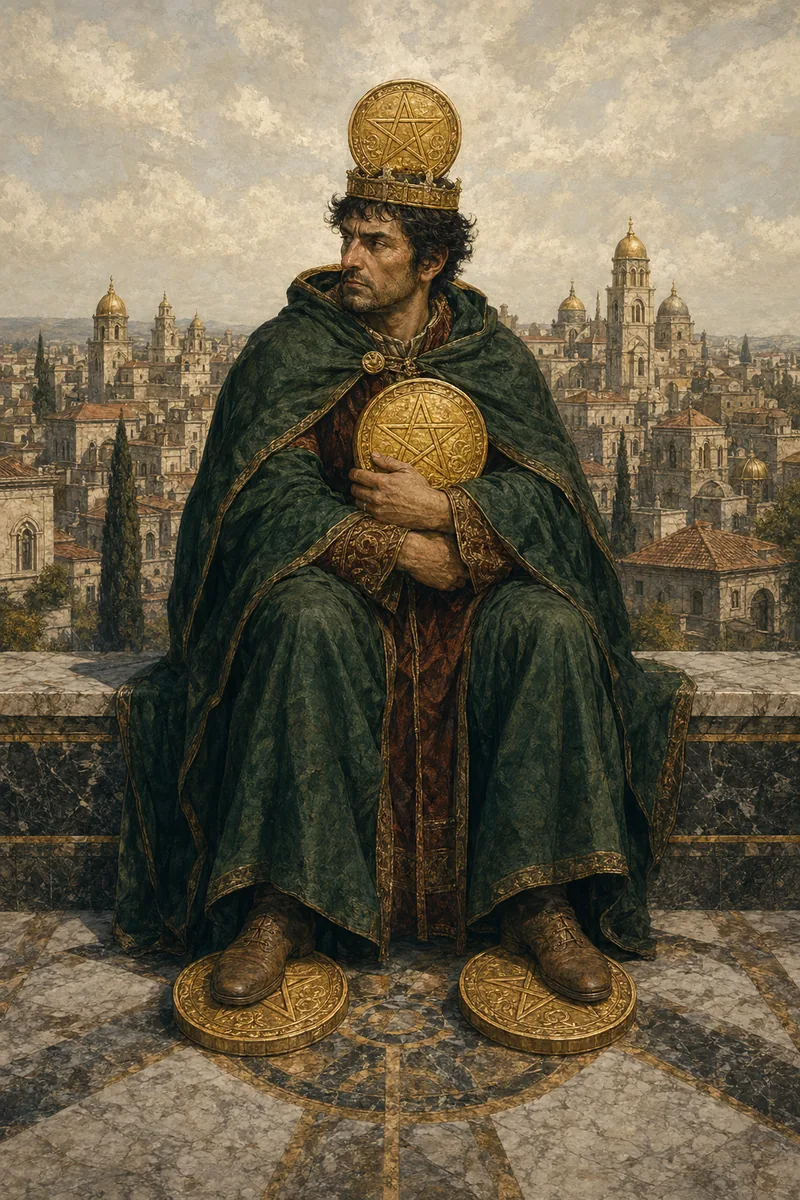
The Four of Pentacles in the Future position is the reading's difficult close, and the friction between it and the reversed Eight of Swords is real — Air and Earth opposing each other, the mental story and the material grip pulling in different directions rather than reinforcing each other. The Four of Pentacles shows a figure clutching coins: one on his head, two under his feet, one held to his chest like a shield. In the context of a love reading, this card in the Future position is not about wealth. It is about security as the highest organizing value in love — holding on not because it is good, but because the alternative is uncertainty, and uncertainty feels like loss. If you stay because leaving is terrifying, if you leave and then immediately try to reconstruct exactly the same level of known stability somewhere else, if relief turns into a new kind of grip — the Four of Pentacles is where you land. It is not a catastrophe, but it is a cage with better furniture. The door is locked from the inside, same as the Eight of Swords, just more comfortable.
Here is what I can tell you plainly: the cards do not answer your question the way you asked it. The relief you feel when you imagine leaving is real data, but the spread is asking whether you have been honest about what it is relief from. The Eight of Cups says something has genuinely run its course — that is true, and it is not nothing. But the Eight of Swords reversed says the story you are telling about your situation has a component you are maintaining, and until you separate what is actually constraining you from what you are choosing to believe about your constraints, any decision — stay or go — risks just being the next shape of the same bind. The Four of Pentacles is not inevitable. It is where this goes if the internal work doesn't happen alongside the external choice.
The practical thing: before you decide anything about him, write down — not in your head, in actual words — the two or three specific things you believe are trapping you in this relationship. Then ask: which of these would disappear if he changed? And which would come with you regardless? The ones in the second column are the Eight of Swords reversed. Those are yours to work with, independent of him, independent of leave-or-stay. The ones in the first column are the actual information about the relationship. Start there.
And when the moment comes — the conversation you've been rehearsing, or the silence that stretches long enough that it speaks for you — that is not the end of this reading. Bring what happened in that moment back, and we read what it opened.