
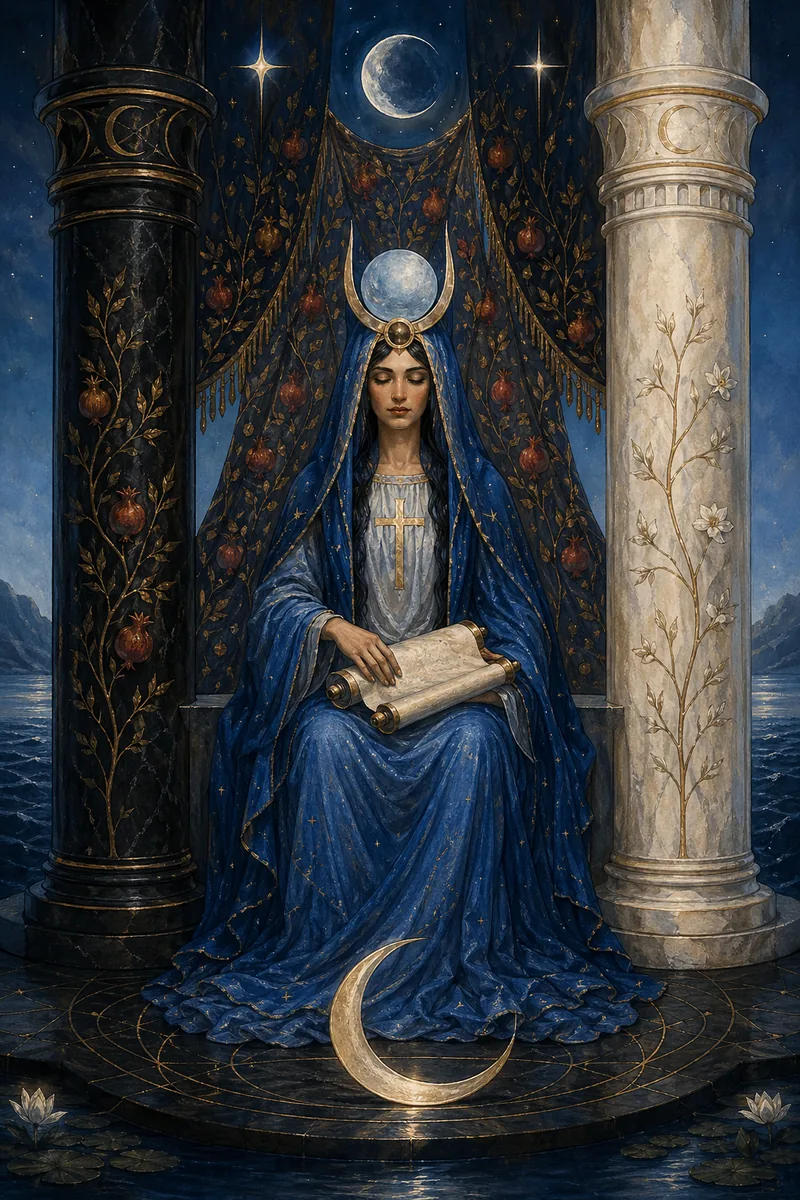
Major Arcana · 2
The High Priestess
La Papesse · La Papessa · The Priestess of the Silver Star
The The High Priestess tarot card meaning runs through both orientations: upright, intuition, the unconscious, inner voice; reversed, secrets withheld, disconnection from intuition, repressed feelings. Below, its imagery across the Rider–Waite–Smith, Thoth, and Marseille decks, and what the tradition’s writers said about it.
- Element
- Water
- Planet
- Moon
- Hebrew
- Gimel
- Numerology
- 2
- Timing
- Lunar cycles — within a moon's turn (28 days); Cancer season; the dark of the moon.
Upright
- intuition
- the unconscious
- inner voice
- mystery
- divine feminine
- dreams
Reversed
- secrets withheld
- disconnection from intuition
- repressed feelings
- superficial knowledge
The High Priestess Tarot Card Meaning
Upright
Listen. The High Priestess speaks in symbol, dream, and gut feeling. The answer you seek won't come from analysis — it will surface in the quiet between thoughts. Honor what you sense before you can prove. The veil thins for those who stop speaking and start receiving.
- Love
- A connection with depth and unspoken understanding. Trust your instincts about a person — what you sense beneath their words is more accurate than what they say. For singles, prepare yourself inwardly; the right person responds to inner readiness, not outer effort.
- Career
- A creative or research-oriented project benefits from incubation rather than action. Don't push for visibility yet. Roles in psychology, healing, art, research, library work, occult practice all favored. Pay attention to the dreams you've been having about your work.
- Finances
- A secret or hidden financial matter is about to surface. Don't make major financial decisions on logic alone — sleep on it, dream on it. Resources may come through unexpected channels.
- Health
- Tune into the body's whispers before they become shouts. Reproductive health, hormonal cycles, emotional-physical link strong now. Sleep and dream-work are medicine.
- Spiritual
- The mystic's path. Contemplation, silence, dream journaling, divination, and ritual deepen your connection. You are receiving downloads — record them. The High Priestess teaches that spiritual knowing is older than spiritual knowledge.
Reversed
Disconnection from intuition, or its inverse — drowning in psychic noise. Either you're overriding your inner voice with external opinions, or you've conflated anxiety with intuition. Discernment is needed: what is felt-sense, what is fear?
- Love
- Hidden information about a partner. Or you're hiding something from yourself about how you feel. Secrets have weight. The cost of revealing is almost always lower than the cost of continuing to conceal.
- Career
- Office politics, hidden agendas, gossip. Or you're suppressing a creative impulse to fit in. Reconnect with the work that matters when no one is watching.
- Finances
- Concealed information in a financial matter. Audit. Read the fine print. Get the records.
- Health
- Ignored symptoms. Disconnection from body cues. Period or hormonal irregularities asking for attention. Insomnia from suppressed emotion.
- Spiritual
- Spiritual materialism — collecting rituals, books, and aesthetics without descent into actual practice. Or fear of the unconscious shadow. The veil cannot be lifted by force.
Those are the card’s meanings in general. A reading tests them against the question the querent actually asked — the person asking is what makes one drawing of The High Priestess differ from the next.
The image, three ways
Rider–Waite–Smith
A serene woman seated between two pillars — one black (Boaz), one white (Jachin) — the entrance to the Temple of Solomon. A blue robe falls in folds resembling water; a crescent moon at her feet. A scroll bearing the letters TORA rests partly hidden in her lap. A veil of pomegranates hangs behind her.
Thoth
The Priestess of the Silver Star — veiled, crowned with the lunar disk of Isis, holding a bow. The image dissolves into geometric patterns, suggesting that the truth she guards is non-figurative.
Marseille
La Papesse — a seated female pope in robes, holding an open book. The 'female pope' image is medieval Europe's repressed memory of the divine feminine in religious authority.
Four ways a reversal speaks
After Mary K. Greer, Tarot Reversals (2002)
01 · denied
Intuition refused; the inner voice overridden by external opinions or anxiety.
02 · shadow
The withholder; secrets kept past their use; mystery as a tool of power.
03 · blocked
The veil thickened into wall; the seeker can no longer access their own knowing.
04 · internalized
Wisdom held privately past usefulness; the closed scroll, the unsaid premonition.
What the tradition says
The tradition consistently places the High Priestess at the boundary between what the conscious mind knows and what lies beneath it. Most readers agree she represents hidden knowledge, inward listening, and the intelligence of the unconscious — a wisdom that does not announce itself but waits to be received in stillness rather than sought through reason.
Where the readings differ: Waite emphasizes external mystery and unrevealed secrets where Pollack and Greer turn the card inward, treating the unconscious as the querent's own living resource; Crowley takes a more cosmological angle, framing her as a lunar initiatory force crossing the Abyss rather than a personal guide to self-knowledge.
A.E. Waite · 1910
The Pictorial Key to the Tarot
Secrets, mystery, the future as yet unrevealed; the woman who interests the Querent. The duality of light and dark mediated by the priestess.
Aleister Crowley · 1944
The Book of Thoth
The Priestess is the influence of the Moon — the path of Gimel that crosses the Abyss. She is initiation through the veil.
Rachel Pollack · 1980
Seventy-Eight Degrees of Wisdom
The unconscious as a living, intelligent presence — not blankness but a mind-beneath-the-mind that speaks in symbol.
Sallie Nichols · 1980
Jung and Tarot: An Archetypal Journey
The High Priestess is the anima in her unspoiled form — the inner feminine before relationship, before mothering, before being defined by the masculine. She holds the threshold between conscious and unconscious without crossing it; her teaching is that some thresholds are guarded for a reason.
Mary K. Greer · 1984
Tarot for Your Self
Greer frames the High Priestess as the inner consultant — the part of the querent that already knows the answer but speaks only in dream, body, and pause. The card asks: when did you last not-think long enough to hear yourself?
Shadow
The withholder; the gatekeeper of false mysteries; the woman who confuses passivity with depth; spiritual snobbery.
Archetypal role
The Mystic / The Oracle / The Hidden Wisdom / The Threshold Guardian
Historical notes
The 'female pope' card haunts the history of tarot. Some scholars connect her to the medieval legend of Pope Joan; others to the Cathar 'Manfreda Visconti,' rumored elected pope by a heretical sect. The image survived ecclesiastical disapproval because tarot was often coded as a game. Waite re-veiled her as the High Priestess to soften the heresy.
The High Priestess: common questions
- Is The High Priestess a yes or no card?
- In a yes-or-no reading, The High Priestess leans maybe.
- What do tarot writers agree The High Priestess means?
- The tradition consistently places the High Priestess at the boundary between what the conscious mind knows and what lies beneath it. Most readers agree she represents hidden knowledge, inward listening, and the intelligence of the unconscious — a wisdom that does not announce itself but waits to be received in stillness rather than sought through…
- What does The High Priestess tarot card mean?
- Listen. The High Priestess speaks in symbol, dream, and gut feeling. The answer you seek won't come from analysis — it will surface in the quiet between thoughts. Honor what you sense before you can prove. The veil thins for those who stop speaking and start receiving.
- What does The High Priestess mean in love?
- A connection with depth and unspoken understanding. Trust your instincts about a person — what you sense beneath their words is more accurate than what they say. For singles, prepare yourself inwardly; the right person responds to inner readiness, not outer effort.
- What does The High Priestess mean for career and money?
- A creative or research-oriented project benefits from incubation rather than action. Don't push for visibility yet. Roles in psychology, healing, art, research, library work, occult practice all favored. Pay attention to the dreams you've been having about your work.
- What does The High Priestess reversed mean?
- Disconnection from intuition, or its inverse — drowning in psychic noise. Either you're overriding your inner voice with external opinions, or you've conflated anxiety with intuition. Discernment is needed: what is felt-sense, what is fear?
Neighbouring arcana
The High Priestess combinations
Last reviewed 2026-06-18
Keep learning
Bring this card into a question
Begin a reading