
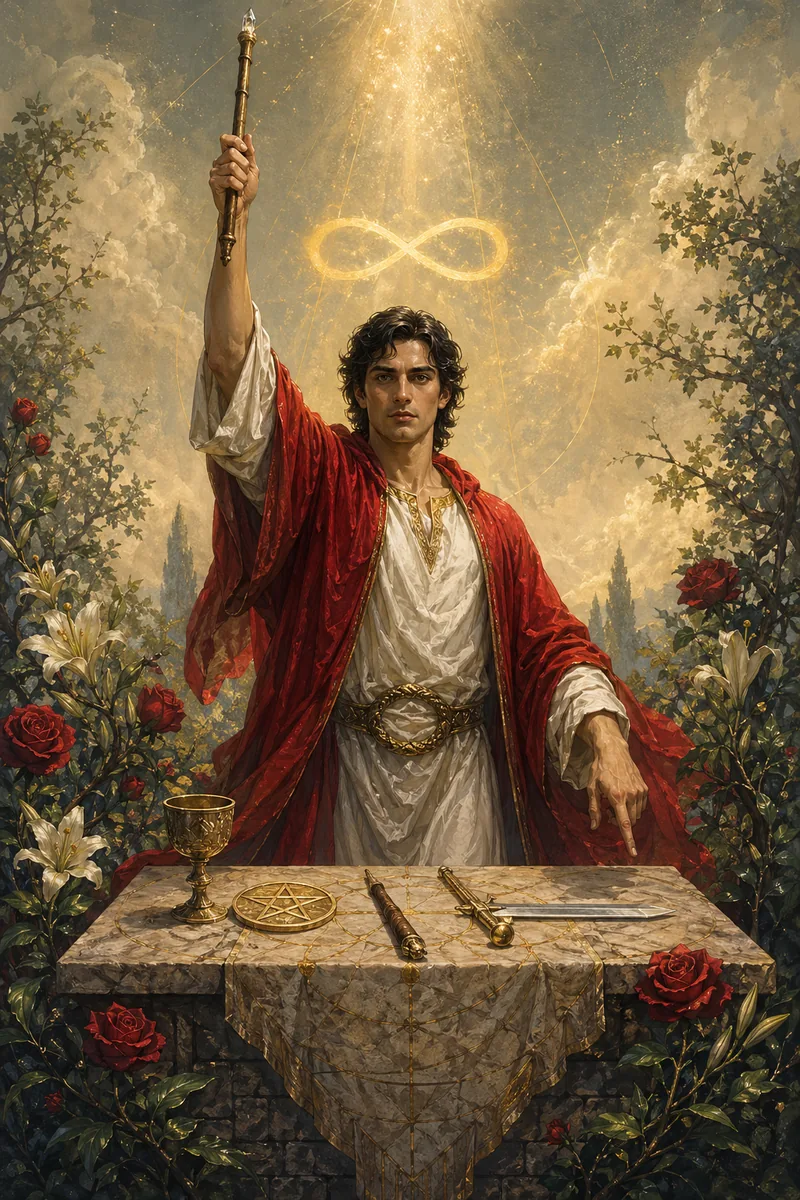
Major Arcana · 1
The Magician
Le Bateleur · Il Bagatto · The Magus
The The Magician tarot card meaning runs through both orientations: upright, manifestation, willpower, skill; reversed, manipulation, trickery, untapped talent. Below, its imagery across the Rider–Waite–Smith, Thoth, and Marseille decks, and what the tradition’s writers said about it.
- Element
- Air
- Planet
- Mercury
- Hebrew
- Beth
- Numerology
- 1
- Timing
- Within the week; Mercury hours (Wednesdays); Gemini and Virgo seasons.
Upright
- manifestation
- willpower
- skill
- concentration
- resourcefulness
- the bridge between worlds
Reversed
- manipulation
- trickery
- untapped talent
- scattered will
- deception
The Magician Tarot Card Meaning
Upright
You have everything you need. The Magician is the channel — the one who consciously directs energy from the higher realms into form. This is the card of focused intention, of skill meeting opportunity. Whatever you commit to now, you can manifest. Concentrate.
- Love
- Powerful chemistry and conscious connection. For singles, the energy you project shapes who you attract — be intentional. For couples, communicate clearly; rekindle through honest dialogue and shared creative projects.
- Career
- Mastery of your craft. Negotiations go well. Public-facing work, communication, sales, teaching, writing — all favored. If you've been hesitating to pitch yourself, now is the time. Mercury energy: speak, write, send.
- Finances
- You can negotiate the deal. Skill-based income flowing. Multiple revenue streams becoming possible. Beware: the Magician can also be a smooth talker — read every contract.
- Health
- Mind-body connection is potent now. Visualization, hypnosis, breathwork, and somatic practices yield strong results. The body responds to focused intention. Communication-related health (throat, hands, lungs) may need care.
- Spiritual
- You are a co-creator with the divine. Ritual, intention-setting, sigil work, and conscious manifestation are your tools. The ordinary becomes sacred when you bring full presence.
Reversed
Power misused, or power unused. Manipulation — by you or someone in your life — must be examined honestly. Alternatively, you have all the tools but are leaving them on the table. What story are you telling yourself about why you can't begin?
- Love
- Charm without depth, love-bombing, manipulation, or relationships built on illusion. Examine where you're performing rather than relating. For couples, communication has become rhetorical instead of vulnerable.
- Career
- All talk, no follow-through. Or imposter syndrome blocking real talent. Watch for workplace manipulation or being sold a vision that has no substance behind it.
- Finances
- Scams, financial deception, or smooth pitches that don't withstand scrutiny. Get a second opinion before signing.
- Health
- Mental scattering, anxiety from overstimulation. Too many open tabs in your nervous system. Simplify. Meditation interrupted by performance ('look at me meditating').
- Spiritual
- Ego inflation in spiritual contexts — the guru complex, the spiritual influencer, the manipulator who weaponizes language. Return to silence.
Those are the card’s meanings in general. A reading tests them against the question the querent actually asked — the person asking is what makes one drawing of The Magician differ from the next.
The image, three ways
Rider–Waite–Smith
A figure stands behind a table holding a wand raised to heaven, his other hand pointing to earth. Above his head floats a lemniscate (infinity symbol). On the table lie the four suits — wand, cup, sword, pentacle. Roses and lilies bloom around him.
Thoth
Mercury in flight, juggling the implements of magick. Multiple translucent figures suggest the swift movement of mind. Crowley emphasizes The Magus as the Word made flesh — the will that shapes reality through symbol.
Marseille
Le Bateleur — a street performer or mountebank at his table, holding a small wand. The earliest meaning was closer to 'juggler' or 'trickster' than mage.
Four ways a reversal speaks
After Mary K. Greer, Tarot Reversals (2002)
01 · shadow
The mage as con artist; charisma weaponized into manipulation; rhetoric without referent.
02 · excessive
All preparation, never starting; or all talk and no follow-through. Tools displayed but never picked up.
03 · blocked
Skill present, will absent. The Magician who keeps preparing as a way of never being judged.
04 · opposite
Trickster instead of mage; the will turned toward distortion rather than truth.
What the tradition says
The tradition broadly agrees that The Magician represents concentrated, directed will — the capacity to take what is already at hand and put it to purposeful use. From Waite's emphasis on skill and address to Pollack's conscious channeling and Greer's inventory of available tools, most readers understand this card as the moment readiness meets intent.
Where the readings differ: Waite grounds the card in practical human skill (and warns of its shadow in snares and loss), where Crowley, DuQuette, and Pollack elevate the figure to a cosmic or philosophical principle — the Word, the Logos, the conscious mind in contact with a power larger than itself.
A.E. Waite · 1910
The Pictorial Key to the Tarot
Skill, diplomacy, address, subtlety; sickness, pain, loss, disaster, snares of enemies.
Aleister Crowley · 1944
The Book of Thoth
The Magus is the Word — the active principle that shapes reality from undifferentiated potential. He calls him 'the will' itself in motion.
Rachel Pollack · 1980
Seventy-Eight Degrees of Wisdom
The Magician represents the conscious mind that recognizes its connection to a greater power and channels that power into form.
Robert M. Place · 2005
The Tarot: History, Symbolism, and Divination
Traces the evolution from Bateleur (juggler) to Magus, showing how Renaissance Hermeticism transformed the figure.
Mary K. Greer · 1984
Tarot for Your Self
The Magician asks the querent to inventory their own tools — what skills, words, gestures, and resources are already on the table that they have not yet picked up. The card's gift is permission to begin.
Lon Milo DuQuette · 2003
Understanding Aleister Crowley's Thoth Tarot
Frames Crowley's Magus as the cosmic Logos — the Word through which the One becomes the Many. The juggling figures show that the Word is never one but always plural, always splitting the divine into the speakable.
Shadow
The con artist; the guru who weaponizes charisma; the procrastinator who keeps preparing instead of starting.
Archetypal role
The Magus / The Mediator / The Communicator / The Trickster
Historical notes
In the Marseille tradition, Le Bateleur is closer to a juggler or street performer — the lowest of the trumps, suggesting that the seeds of magic are found in the marketplace, not the temple. Waite elevated him into the mystical mage we recognize today; Crowley made him cosmic. The shift from 'street magician' to 'mage' parallels the occult revival of the late 19th century.
The Magician: common questions
- Is The Magician a yes or no card?
- In a yes-or-no reading, The Magician leans yes.
- What do tarot writers agree The Magician means?
- The tradition broadly agrees that The Magician represents concentrated, directed will — the capacity to take what is already at hand and put it to purposeful use. From Waite's emphasis on skill and address to Pollack's conscious channeling and Greer's inventory of available tools, most readers understand this card as the moment readiness meets intent.
- What does The Magician tarot card mean?
- You have everything you need. The Magician is the channel — the one who consciously directs energy from the higher realms into form. This is the card of focused intention, of skill meeting opportunity. Whatever you commit to now, you can manifest. Concentrate.
- What does The Magician mean in love?
- Powerful chemistry and conscious connection. For singles, the energy you project shapes who you attract — be intentional. For couples, communicate clearly; rekindle through honest dialogue and shared creative projects.
- What does The Magician mean for career and money?
- Mastery of your craft. Negotiations go well. Public-facing work, communication, sales, teaching, writing — all favored. If you've been hesitating to pitch yourself, now is the time. Mercury energy: speak, write, send.
- What does The Magician reversed mean?
- Power misused, or power unused. Manipulation — by you or someone in your life — must be examined honestly. Alternatively, you have all the tools but are leaving them on the table. What story are you telling yourself about why you can't begin?
Neighbouring arcana
The Magician combinations
Last reviewed 2026-06-18
Keep learning
Bring this card into a question
Begin a reading