
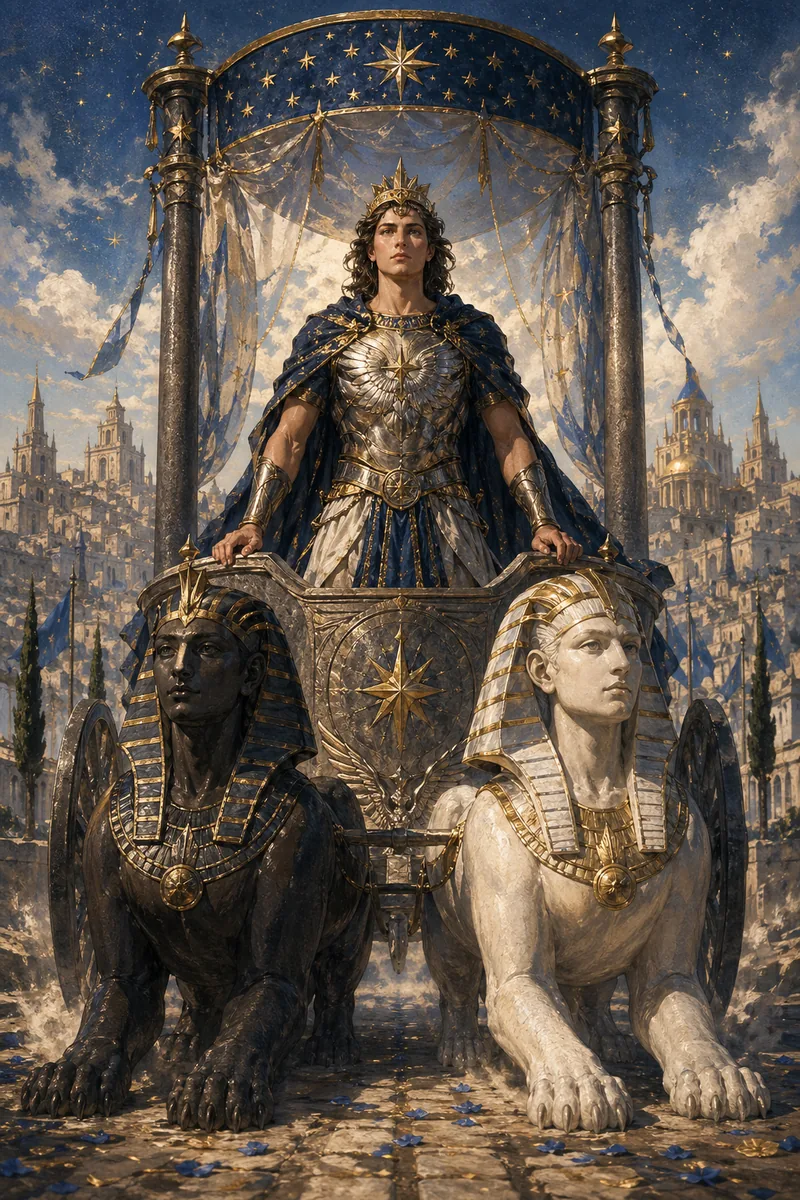
Major Arcana · 7
The Chariot
Le Chariot · Il Carro
The The Chariot tarot card meaning runs through both orientations: upright, willpower, determination, control; reversed, loss of control, scattered direction, aggression. Below, its imagery across the Rider–Waite–Smith, Thoth, and Marseille decks, and what the tradition’s writers said about it.
- Element
- Water
- Planet
- Moon
- Zodiac
- Cancer
- Hebrew
- Cheth
- Numerology
- 7
- Timing
- Cancer season (June–July); within months; Mondays (Moon day); summer solstice phase.
Upright
- willpower
- determination
- control
- victory
- drive
- focus
Reversed
- loss of control
- scattered direction
- aggression
- self-doubt
- stalled momentum
The Chariot Tarot Card Meaning
Upright
Move. The Chariot is harnessed will — the moment when inner contradictions are bound together by clear intention and propelled forward. Victory comes through focus, not force. You don't need reins; you need direction. Where will you point this energy?
- Love
- Pursuit, commitment, going public with the relationship. For singles, taking initiative — making the move, asking out, defining the relationship. For couples, navigating an external challenge as a team.
- Career
- Promotion, victory, achievement of a long-pursued goal. Travel for work. Roles in transportation, logistics, military, athletics, leadership. Push through — you have the momentum.
- Finances
- Financial gains through disciplined action. Aggressive savings goals met. A negotiation won. Don't lose focus when the win comes.
- Health
- Strength, athletic discipline, recovery from illness through willpower. Watch for stress on the digestive system (Cancer rules the stomach). Don't bulldoze the body's needs.
- Spiritual
- The will-aligned-with-purpose. Spiritual warriorship. Discipline of practice that produces breakthroughs. The Chariot also rules the body as the vehicle of incarnation — honor it.
Reversed
The reins are in many hands. Direction unclear, momentum lost, or aggression replacing alignment. Sometimes the Chariot reversed is forcing what should be allowed; other times it's coasting when initiative is required. Discern which.
- Love
- Power struggle. One partner pushing, the other resisting. Or the relationship lacks direction — stalled, drifting. Recommit or release.
- Career
- Burnout from forcing. Or stagnation, lost direction. A project derailed. Pause and re-aim before pushing harder.
- Finances
- Reckless spending or stalled financial momentum. Aggressive investing without strategy. Or paralysis preventing action.
- Health
- Pushing the body past sustainable limits — injury, exhaustion. Digestive issues from stress. The body is not a machine; recover.
- Spiritual
- Spiritual will weaponized — using practice to control rather than to liberate. Or abandoning practice because progress feels stalled.
Those are the card’s meanings in general. A reading tests them against the question the querent actually asked — the person asking is what makes one drawing of The Chariot differ from the next.
The image, three ways
Rider–Waite–Smith
A crowned warrior stands in an ornate stone chariot pulled by two sphinxes — one black, one white. He holds no reins; the city he leaves rises behind him; a starry canopy crowns the chariot.
Thoth
An armored figure holding the Holy Grail aloft, drawn by four sphinxes representing the four elements. The card emphasizes the bearer of the cup of consciousness rather than the conqueror.
Marseille
Le Chariot — a young king stands in a square chariot drawn by two horses (or sometimes sphinxes) facing different directions. The horses' divergence is the central tension.
Four ways a reversal speaks
After Mary K. Greer, Tarot Reversals (2002)
01 · blocked
Stalled momentum; the will scattered; direction unchosen, so motion is impossible.
02 · excessive
Bulldozing; force where alignment was needed; driving over what should be invited along.
03 · opposite
Loss of control; the sphinxes pulling different directions, no one steering.
04 · internalized
The fight inside the self; will at war with itself rather than directed outward.
What the tradition says
The tradition broadly agrees that the Chariot marks a turning point from preparation to forward movement — a moment when opposing forces are held together by concentrated will rather than resolved or eliminated. Most readers treat this as the card of effective, directed agency: not passive luck, but harnessed intention producing real-world advance.
Where the readings differ: Waite reads the Chariot as outward triumph and health where Crowley and DuQuette emphasize an interior cargo — what the warrior carries matters more than where they arrive — while Pollack frames the card as the ego's peak competence and Greer as the moment choice itself becomes available.
A.E. Waite · 1910
The Pictorial Key to the Tarot
Triumph, victory, conquest, presence of mind, health. The Chariot is the moment of decisive movement after long preparation.
Aleister Crowley · 1944
The Book of Thoth
Cancer the watery sign; the Chariot as the carrier of the Holy Grail of consciousness across the abyss. The warrior who holds the cup is greater than the warrior who holds the sword.
Rachel Pollack · 1980
Seventy-Eight Degrees of Wisdom
The Chariot represents the constructed self — the ego at its most effective, capable of holding contradictions in productive tension. But it is not yet enlightenment; the next card, Strength, reveals what the ego cannot do alone.
Mary K. Greer · 1984
Tarot for Your Self
Greer treats the Chariot as the moment of choosing destination over drift. She has the querent name three places they could direct this energy — and recognize the cost of each. The Chariot does not choose for you; it tells you a choice is now possible.
Lon Milo DuQuette · 2003
Understanding Aleister Crowley's Thoth Tarot
DuQuette reads the Thoth Chariot's Holy Grail as the sole meaningful cargo of the warrior — what the soul carries through the field of polarities is the only victory worth winning. The four sphinxes are the four elements bound to serve the Grail-bearer.
Shadow
The bulldozer; the achiever who confuses motion with meaning; the aggressor who calls dominance victory; the burnt-out warrior.
Archetypal role
The Hero / The Conqueror / The Charioteer / The Warrior-King
Historical notes
The Chariot is one of the oldest images in tarot, drawn from triumphal Roman processions and Renaissance triumphi. The 'merkaba' (Hebrew for chariot) is a deep mystical symbol — the chariot of God in Ezekiel's vision became a central image of Jewish mysticism. Crowley's Thoth Chariot leans into this — the warrior bears the Grail rather than weapons.
The Chariot: common questions
- Is The Chariot a yes or no card?
- In a yes-or-no reading, The Chariot leans yes.
- What do tarot writers agree The Chariot means?
- The tradition broadly agrees that the Chariot marks a turning point from preparation to forward movement — a moment when opposing forces are held together by concentrated will rather than resolved or eliminated. Most readers treat this as the card of effective, directed agency: not passive luck, but harnessed intention producing real-world advance.
- What does The Chariot tarot card mean?
- Move. The Chariot is harnessed will — the moment when inner contradictions are bound together by clear intention and propelled forward. Victory comes through focus, not force. You don't need reins; you need direction. Where will you point this energy?
- What does The Chariot mean in love?
- Pursuit, commitment, going public with the relationship. For singles, taking initiative — making the move, asking out, defining the relationship. For couples, navigating an external challenge as a team.
- What does The Chariot mean for career and money?
- Promotion, victory, achievement of a long-pursued goal. Travel for work. Roles in transportation, logistics, military, athletics, leadership. Push through — you have the momentum.
- What does The Chariot reversed mean?
- The reins are in many hands. Direction unclear, momentum lost, or aggression replacing alignment. Sometimes the Chariot reversed is forcing what should be allowed; other times it's coasting when initiative is required. Discern which.
Neighbouring arcana
The Chariot combinations
Last reviewed 2026-06-18
Keep learning
Bring this card into a question
Begin a reading