
Major Arcana · 15
The Devil
Le Diable · Il Diavolo · Pan
The The Devil tarot card meaning runs through both orientations: upright, bondage, addiction, shadow; reversed, liberation, release, shadow integration. Below, its imagery across the Rider–Waite–Smith, Thoth, and Marseille decks, and what the tradition’s writers said about it.
- Element
- Earth
- Planet
- Saturn
- Zodiac
- Capricorn
- Hebrew
- Ayin
- Numerology
- 15
- Timing
- Capricorn season (December–January); Saturday (Saturn day); slow timeframes — the chain comes off gradually.
Upright
- bondage
- addiction
- shadow
- materialism
- obsession
- the unexamined contract
Reversed
- liberation
- release
- shadow integration
- breaking free
- reclaiming power
The Devil Tarot Card Meaning
Upright
What are you bound to? The Devil is the unexamined contract — addiction, codependence, materialism, obsession, the relationship that you stay in for reasons you don't say out loud. The chains are loose. You forgot you can take them off. Or you remember and choose them anyway. Why?
- Love
- Toxic attraction. Sexual obsession, codependence, abusive dynamics. Or, more mildly, a relationship sustained by lust or fear rather than love. For couples, the contract that has become a cage. For singles, falling for the same wound type. Examine the chain.
- Career
- Golden handcuffs — staying for the salary, status, or fear of leaving. Workaholism. Industries you know are harmful. The role that has eaten your identity. What are you bound to that has gone past serving you?
- Finances
- Consumer debt, gambling, materialism as identity. Or, money-anxiety so consuming it dominates the psyche. Money has become master, not servant.
- Health
- Addiction — substance, food, sex, screens, work, drama. The dopamine loops. Chronic stress from carrying the chain. Skin and bones (Capricorn) — the structural body asking for attention.
- Spiritual
- Materialism mistaken for the only real. Or, spiritual addiction — the high of practice without the depth. The shadow demanding attention. What you don't face, you serve.
Reversed
Liberation. The chain is being seen for what it is. The contract is being read at last. Reclaiming power from what owned you — the addiction, the relationship, the ideology, the trauma response. This is rarely easy and rarely linear. But the chain is loose.
- Love
- Leaving the toxic dynamic. Or, deepening intimacy by facing the shadow within the relationship. The 'I won't do this anymore.' For singles, the pattern recognized and refused.
- Career
- Quitting the job that owned you. Or, reclaiming power within the role by changing the contract. Whistleblowing. Refusing the golden handcuffs.
- Finances
- Paying off debt. Refusing materialist identity. The recognition that more money won't fill the inner gap.
- Health
- Recovery from addiction. Therapy. Somatic work that releases what the body held. Long process, not single moment. Honor the gradient.
- Spiritual
- Shadow integration done well. The Devil befriended is no longer the Devil. Pan reclaimed.
Those are the card’s meanings in general. A reading tests them against the question the querent actually asked — the person asking is what makes one drawing of The Devil differ from the next.
The image, three ways
Rider–Waite–Smith
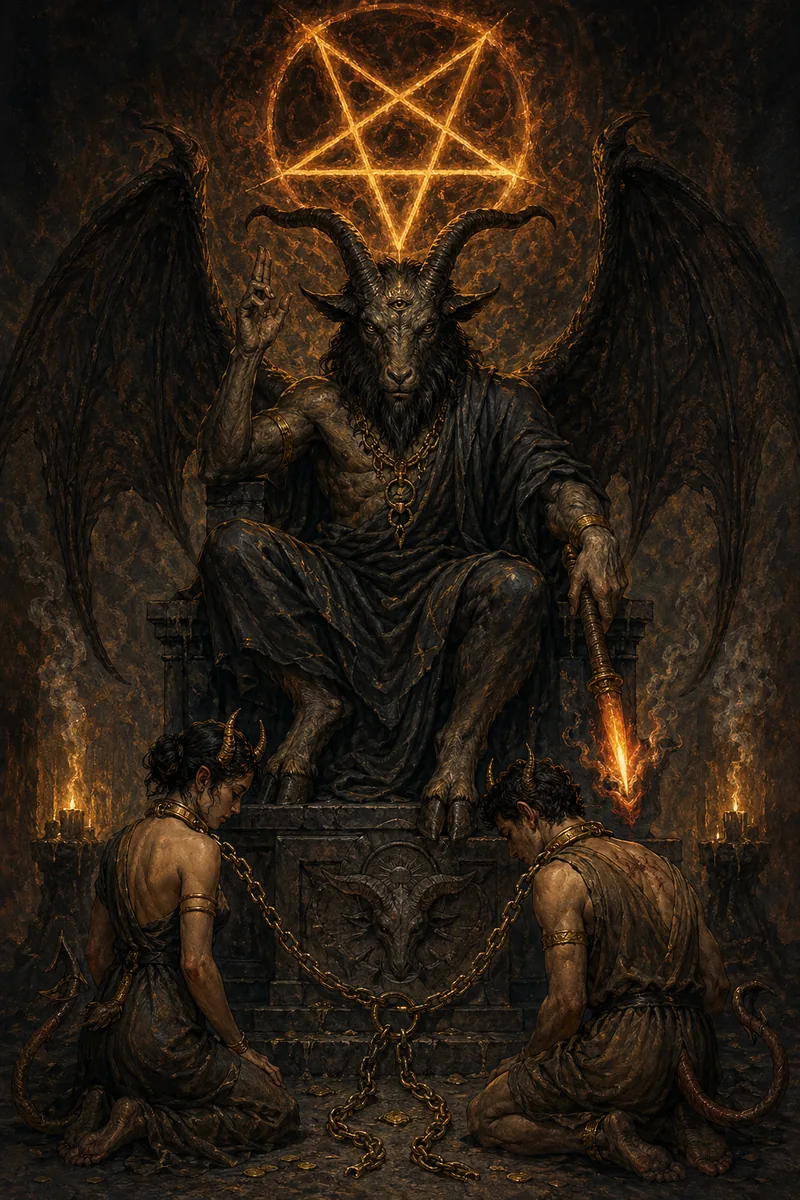
A horned, bat-winged figure squats on a pedestal. A naked man and woman, horned and tailed themselves, are chained at the neck to the pedestal — but the chains are loose enough to slip off. An inverted pentagram glows above the Devil's head; one hand makes a sign, the other holds a torch.
Thoth
A satyr-Pan figure with a goat's head, an enormous phallus, and the third eye open. Crowley reframes the Devil as Pan — the all (pan), the generative god demonized by repressive religion.
Marseille
Le Diable — a hairy, hermaphroditic devil holding a torch downward, with two small horned figures chained at his feet. More medieval-grotesque than the Waite reading.
Four ways a reversal speaks
After Mary K. Greer, Tarot Reversals (2002)
01 · shadow
The unexamined contract; the chain forgotten until it tightens; what owns you that you haven't named.
02 · blocked
Recognition refused; the chain still loose but the seeker still bound by story.
03 · returning
The compulsion re-emerging after thought-conquered; the addiction's quiet return.
04 · excessive
The bondage taken to extremes; addiction that has become identity.
What the tradition says
The tradition broadly agrees that the Devil names a condition of bondage that is not truly inescapable — the chains exist, but loosely. Most readers locate the card's real subject in the examined life: what holds you, why you allow it, and whether the attachment is suffered or, at some level, chosen. The card is about consciousness, not condemnation.
Where the readings differ: Waite reads the Devil as fatality and overwhelming force where Crowley reclaims it as sacred generative power, while Snow extends that rehabilitation further by distinguishing oppressive bondage from desires merely stigmatized by the same cultural authority that created the stigma — a distinction Pollack and Greer leave largely unaddressed.
A.E. Waite · 1910
The Pictorial Key to the Tarot
Ravage, violence, vehemence, extraordinary efforts, force, fatality; that which is predestined but not for this reason evil.
Aleister Crowley · 1944
The Book of Thoth
Pan — the All. The card of generative joy slandered by repressive religion. The third eye open in the goat-god is the secret: matter is divine, not opposed to spirit.
Rachel Pollack · 1980
Seventy-Eight Degrees of Wisdom
The Devil represents the moment of confronting the shadow — what we have been bound to in unawareness. The chains are loose; awareness is the loosening.
Mary K. Greer · 1984
Tarot for Your Self
Greer's question for the Devil's querent: what is the payoff? Every chain pays, or it would already be gone. The card's intelligence asks the seeker to articulate the secondary gain honestly before they can authentically choose to stop receiving it.
Cassandra Snow · 2019
Queering the Tarot
Snow rereads the Devil away from the moralistic frame — many things called 'devilish' (queerness, kink, embodied desire) were demonized by the same religious authority that made the Hierophant. The card's true work is distinguishing genuine bondage (codependence, addiction, abuse) from the merely-stigmatized aliveness.
Shadow
The addict; the abuser; the materialist; the one who sells their power and calls it pragmatism. The Devil's true work is convincing you the chain is your skin.
Archetypal role
Pan / The Tempter / The Shadow / The Bound One
Historical notes
The Devil card emerged with Christian Europe's projection of pagan deities — particularly Pan and Dionysus — into demonic figures. Crowley's reclaiming of Pan as the all-god, the generative principle slandered by repressive religion, is one of his most theologically subversive moves. The Hebrew letter Ayin means 'eye' — the Devil is the seen, the manifest, the material taken as ultimate.
The Devil: common questions
- Is The Devil a yes or no card?
- In a yes-or-no reading, The Devil leans no (the answer to the question being asked is usually 'this binds you').
- What do tarot writers agree The Devil means?
- The tradition broadly agrees that the Devil names a condition of bondage that is not truly inescapable — the chains exist, but loosely. Most readers locate the card's real subject in the examined life: what holds you, why you allow it, and whether the attachment is suffered or, at some level, chosen. The card is…
- What does The Devil tarot card mean?
- What are you bound to? The Devil is the unexamined contract — addiction, codependence, materialism, obsession, the relationship that you stay in for reasons you don't say out loud. The chains are loose. You forgot you can take them off. Or you remember and choose them anyway. Why?
- What does The Devil mean in love?
- Toxic attraction. Sexual obsession, codependence, abusive dynamics. Or, more mildly, a relationship sustained by lust or fear rather than love. For couples, the contract that has become a cage. For singles, falling for the same wound type. Examine the chain.
- What does The Devil mean for career and money?
- Golden handcuffs — staying for the salary, status, or fear of leaving. Workaholism. Industries you know are harmful. The role that has eaten your identity. What are you bound to that has gone past serving you?
- What does The Devil reversed mean?
- Liberation. The chain is being seen for what it is. The contract is being read at last. Reclaiming power from what owned you — the addiction, the relationship, the ideology, the trauma response. This is rarely easy and rarely linear. But the chain is loose.
Neighbouring arcana
The Devil combinations
Last reviewed 2026-06-18
Keep learning
Bring this card into a question
Begin a reading