
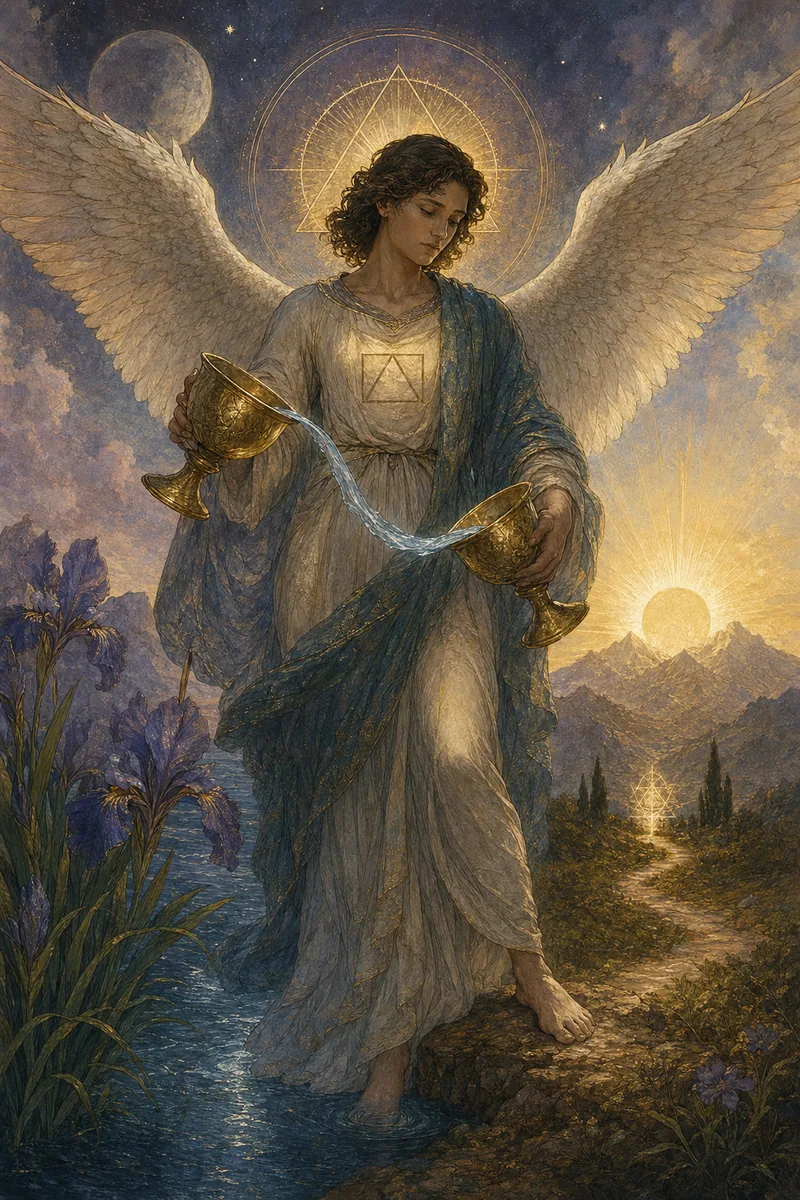
Major Arcana · 14
Temperance
La Tempérance · La Temperanza · Art (Thoth)
The Temperance tarot card meaning runs through both orientations: upright, balance, moderation, alchemy; reversed, imbalance, excess, extremes. Below, its imagery across the Rider–Waite–Smith, Thoth, and Marseille decks, and what the tradition’s writers said about it.
- Element
- Fire
- Planet
- Jupiter
- Zodiac
- Sagittarius
- Hebrew
- Samekh
- Numerology
- 14
- Timing
- Sagittarius season (November–December); the long view — months to a year; Thursday (Jupiter day).
Upright
- balance
- moderation
- alchemy
- patience
- blending
- integration
Reversed
- imbalance
- excess
- extremes
- lack of long-term vision
- self-medication
Temperance Tarot Card Meaning
Upright
Blend. Temperance is the art of holding opposites without collapsing them — the patience of the alchemist who knows the gold takes time to form. This is the card of the long view, the steady fire, the conscious mixing of disparate elements into something new. Don't rush the cure.
- Love
- Patient, healthy partnership. Compromise without self-loss. For couples, balance after a turbulent phase. For singles, integration of past relationships' lessons before entering a new one.
- Career
- Work-life balance. Roles requiring synthesis — therapy, teaching, design, mediation, alchemy in any form. A long project that yields a refined result. Patient mastery.
- Finances
- Moderate, balanced approach. Diversification. The middle path between hoarding and reckless spending. Slow, steady growth.
- Health
- Balance — exercise and rest, intake and output. Recovery through gentle, patient practice. Hips and thighs (Sagittarius). Healing addictions through integration rather than white-knuckling.
- Spiritual
- The alchemical work. Shadow integration. The middle way of the Buddha. Spiritual practice that holds opposites in dialogue rather than choosing sides.
Reversed
Excess in one direction or another. Either overindulgence or rigid abstinence — both miss the temperance. Self-medication, addiction, burnout, or the inverse, perfectionism that has lost the human warmth. Find the middle.
- Love
- Imbalance — one-sided giving, codependence, or rigid emotional control. Recalibrate before the imbalance becomes structural.
- Career
- Workaholic burnout. Or, scattered focus across too many projects. The art of synthesis is missing.
- Finances
- Reckless spending or austerity-as-virtue. Both starve the soul. Find the middle path.
- Health
- Addiction, eating disorders, self-medication. Or, perfectionist health regimens that have become punishing. The body asks for kindness, not control.
- Spiritual
- Spiritual extremism. Either fanatical practice or no practice. The middle way is the harder one.
Those are the card’s meanings in general. A reading tests them against the question the querent actually asked — the person asking is what makes one drawing of the Temperance differ from the next.
The image, three ways
Rider–Waite–Smith
A winged angel — neither clearly male nor female — pours water between two cups, the stream flowing impossibly between them. One foot rests on land, the other in water. The sun rises over distant mountains; irises bloom; a path leads to a crowned light.
Thoth
Renamed Art. A two-headed (or four-headed) alchemical figure pours water and fire into a single cauldron, blending opposites. Crowley emphasizes the laboratory of the soul.
Marseille
La Tempérance — a winged figure pours liquid between two pitchers. Less elaborate than later versions but containing the central image.
Four ways a reversal speaks
After Mary K. Greer, Tarot Reversals (2002)
01 · excessive
Over-mixing into mush; the alchemist who keeps stirring past the gold; immoderation in any direction.
02 · blocked
Impatience; the cure rushed; the slow integration interrupted.
03 · opposite
Extremes — overindulgence or rigid abstinence — both failures of the middle way.
04 · internalized
Self-medication; the blending done privately and badly to avoid the public work.
What the tradition says
The tradition broadly agrees that Temperance is a card of active, skilled mixing rather than passive balance. Most readers understand it as a process — the deliberate combining of opposing elements over time — and connect it to patience, moderation, and the slow production of something that could not exist without that careful work.
Where the readings differ: Waite reads the card as economy and accommodation within an orderly life where Crowley and DuQuette push further, framing the same process as the alchemical Great Work in which opposites are not merely held together but transformed into an entirely new substance, while Greer locates this transformation not in high magic but in the unglamorous accumulation of small daily practice.
A.E. Waite · 1910
The Pictorial Key to the Tarot
Economy, moderation, frugality, management, accommodation. The angel of life, of solar fire, of the secret of the Royal Marriage.
Aleister Crowley · 1944
The Book of Thoth
Art — the laboratory of soul-making. The marriage of the white queen and red king blending in the cauldron. Sagittarius — the arrow toward illumination.
Rachel Pollack · 1980
Seventy-Eight Degrees of Wisdom
Temperance is the moment of integration after the death of Death — the soul reassembling itself from the ashes, but consciously this time.
Mary K. Greer · 1984
Tarot for Your Self
Greer locates Temperance's work in the small daily blendings — the cup of coffee that holds rest and stimulation, the conversation that holds truth and care. The card's mastery is unglamorous, accumulating through practice rather than insight.
Lon Milo DuQuette · 2003
Understanding Aleister Crowley's Thoth Tarot
DuQuette unpacks Crowley's title 'Art' as the Great Work itself — solve et coagula, the alchemical instruction to dissolve and recoagulate. The card is the laboratory of soul-making, where opposites are not balanced but actively cooked into a third thing that did not previously exist.
Shadow
The lukewarm — temperance confused with neutrality; the conflict-avoider who calls compromise balance; the slow-walker who never decides.
Archetypal role
The Alchemist / The Healer / The Integrator / The Patient Master
Historical notes
Temperance was originally one of the four cardinal virtues (with Justice, Strength, and Prudence — the latter often missing from tarot). The angel pouring water between cups is a medieval image of moderating wine — the practical, daily virtue elevated to spiritual practice. Crowley renamed it Art to reclaim the alchemical dimension lost in 'temperance' — which had become moralistic in English usage.
Temperance: common questions
- Is the Temperance a yes or no card?
- In a yes-or-no reading, the Temperance leans yes.
- What do tarot writers agree the Temperance means?
- The tradition broadly agrees that Temperance is a card of active, skilled mixing rather than passive balance. Most readers understand it as a process — the deliberate combining of opposing elements over time — and connect it to patience, moderation, and the slow production of something that could not exist without that careful work.
- What does the Temperance tarot card mean?
- Blend. Temperance is the art of holding opposites without collapsing them — the patience of the alchemist who knows the gold takes time to form. This is the card of the long view, the steady fire, the conscious mixing of disparate elements into something new. Don't rush the cure.
- What does the Temperance mean in love?
- Patient, healthy partnership. Compromise without self-loss. For couples, balance after a turbulent phase. For singles, integration of past relationships' lessons before entering a new one.
- What does the Temperance mean for career and money?
- Work-life balance. Roles requiring synthesis — therapy, teaching, design, mediation, alchemy in any form. A long project that yields a refined result. Patient mastery.
- What does the Temperance reversed mean?
- Excess in one direction or another. Either overindulgence or rigid abstinence — both miss the temperance. Self-medication, addiction, burnout, or the inverse, perfectionism that has lost the human warmth. Find the middle.
Neighbouring arcana
Temperance combinations
Last reviewed 2026-06-18
Keep learning
Bring this card into a question
Begin a reading