
Major Arcana · 13
Death
La Mort · La Morte · The Reaper
The Death tarot card meaning runs through both orientations: upright, transformation, endings, transition; reversed, resistance to change, stagnation, fear of endings. Below, its imagery across the Rider–Waite–Smith, Thoth, and Marseille decks, and what the tradition’s writers said about it.
- Element
- Water
- Planet
- Pluto
- Zodiac
- Scorpio
- Hebrew
- Nun
- Numerology
- 13
- Timing
- Scorpio season (October–November); within a season; transformative timeframes; new moon energy.
Upright
- transformation
- endings
- transition
- rebirth
- letting go
- metamorphosis
Reversed
- resistance to change
- stagnation
- fear of endings
- incomplete transformation
Death Tarot Card Meaning
Upright
Something is ending so something can begin. Death is rarely literal — it is the card of transformation, the chapter closing, the identity outgrown. What dies wants to die. The grief is honest; the resistance is not. Let it go. What's coming requires the room.
- Love
- End of a relationship that has run its course — or end of a relational pattern within an existing partnership (which may save it). For singles, the death of an old story about love that opens room for a new one.
- Career
- End of a job, a role, a career chapter. Layoff, resignation, retirement, pivot. Or, the death of a workplace identity that has stopped serving you. The 'should' that finally goes.
- Finances
- End of a financial chapter — paying off a debt, closing an account, divestment. Sometimes loss; sometimes liberation through loss.
- Health
- Major change in the body — recovery from illness on the other side of suffering. The end of a habit. Hormonal transition. Sometimes literal death of someone in your life. Grief as physical process.
- Spiritual
- Ego death. The dark night. The metamorphosis chamber. What you were is no longer; what you are becoming is not yet visible. Trust the dissolution.
Reversed
Resistance to the necessary ending. Holding on to what is already gone. Or, the slow form of dying where transformation is interrupted and you remain in the chrysalis indefinitely. The reversal is not 'no death' — it is 'incomplete death.' Complete it.
- Love
- Refusing to acknowledge the relationship is over. Or being unable to let go of an ex. The half-ending that prevents new love.
- Career
- Clinging to a job long past its usefulness. Or, refusing to grieve the career you didn't pursue.
- Finances
- Avoiding closing a chapter — debt, partnership, contract — that needs to end. Or, financial fear keeping you in a dying situation.
- Health
- Chronic conditions where transformation is stalled. Unprocessed grief somatized. Resistance to lifestyle changes the body is demanding.
- Spiritual
- Stuck in transition — neither the old self nor the new. The chrysalis with no exit. Often requires support — therapy, ritual, community.
Those are the card’s meanings in general. A reading tests them against the question the querent actually asked — the person asking is what makes one drawing of the Death differ from the next.
The image, three ways
Rider–Waite–Smith
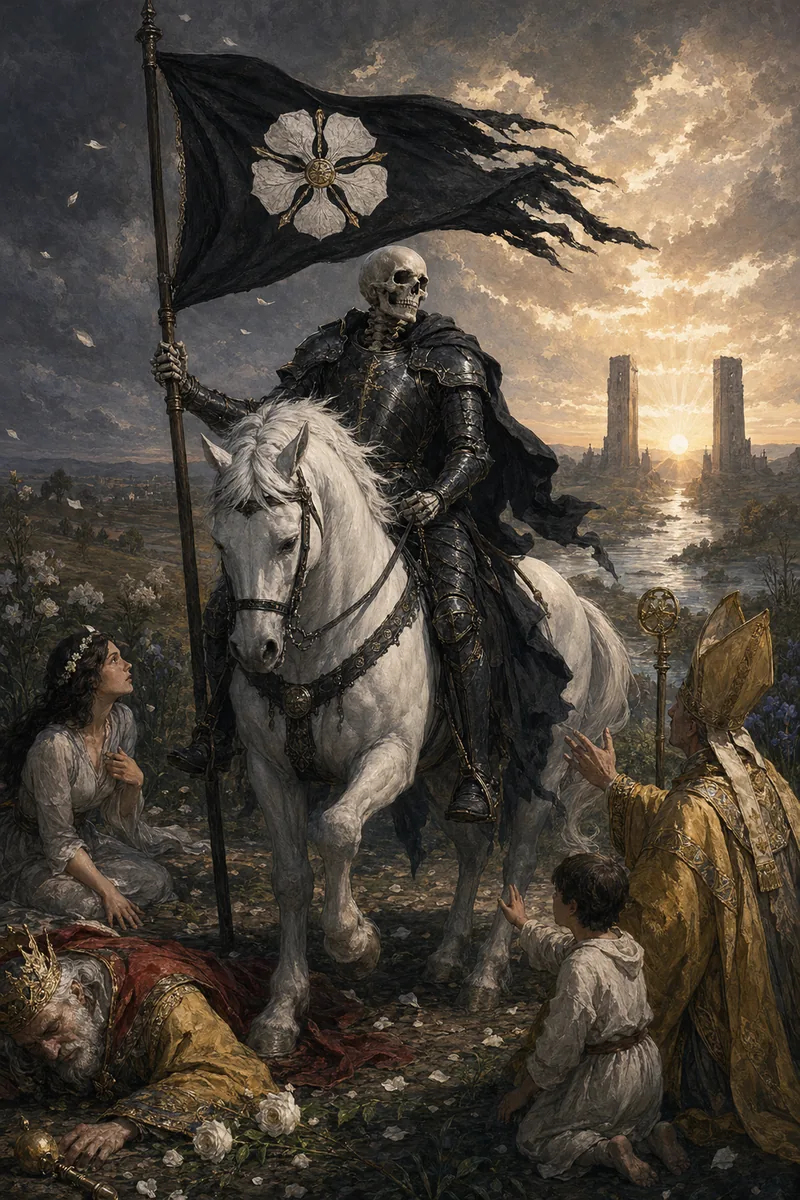
A skeletal figure in black armor rides a white horse, holding a black banner with a white five-petaled rose. A king lies fallen; a child, a bishop, and a maiden face the rider. The sun rises (or sets) between two towers in the distance; a river flows.
Thoth
A skeletal scythe-bearer dancing amid swirling fish, scorpions, and serpents — symbols of regeneration. Crowley emphasizes Death as the gateway, not the gate.
Marseille
La Mort (often unnamed — the only card sometimes left unnamed in the Marseille tradition out of superstition) — a skeleton with a scythe stands in a field strewn with limbs and heads. Brutal, agricultural.
Four ways a reversal speaks
After Mary K. Greer, Tarot Reversals (2002)
01 · blocked
Refusing the necessary ending; gripping what is already dying.
02 · delayed
The transformation paused mid-passage; stuck in chrysalis without exit.
03 · denied
What is over treated as still alive; the corpse propped up in its old chair.
04 · karmic
An ancestral pattern coming to its long-overdue close; generational death asking to be honored.
What the tradition says
The tradition agrees that Death is a card of transformation rather than literal ending. Most readers understand it as depicting necessary loss — the clearing away of what has run its course so that something new can take its place. The grief attending this card is treated as real and appropriate; only the refusal to release what is already gone is considered a mistake.
Where the readings differ: Waite reads Death with genuine grimness — corruption, destruction, the loss of benefactors — where Crowley and Pollack emphasize transformation as cause for something closer to celebration or acceptance, and Greer adds a ritual dimension Waite does not consider, insisting the leaving deserves formal acknowledgment before the door closes.
A.E. Waite · 1910
The Pictorial Key to the Tarot
End, mortality, destruction, corruption; for a man, the loss of a benefactor; for a woman, many contrarieties. Waite is grimmer than later interpretations.
Aleister Crowley · 1944
The Book of Thoth
Death as Scorpio — the deep regenerative water. The skeleton dances; transformation is celebration, not tragedy.
Rachel Pollack · 1980
Seventy-Eight Degrees of Wisdom
Death is the moment when the seeker realizes that change is not interruption of life but its substance — that we are made of endings as much as beginnings.
Sallie Nichols · 1980
Jung and Tarot: An Archetypal Journey
Nichols reads Death as the alchemical nigredo — the necessary blackening that precedes the gold. The skeleton on the white horse is psyche stripped to structure; everything inessential is taken so the essential can emerge. To meet Death without fear requires having something underneath persona that is not afraid.
Mary K. Greer · 1984
Tarot for Your Self
Greer asks the Death querent to write their own elegy for what is leaving — to honor what was real before allowing it to go. Death without ritual leaves the bones unburied; the card's medicine includes the formal goodbye, not just the parting.
Shadow
The grim reaper internalized — calling everything dead too soon, ending what could heal; or the inverse, refusing every ending and accumulating ghosts.
Archetypal role
The Reaper / The Initiator into Mysteries / The Lord of Endings
Historical notes
Death was the most feared card in early decks — sometimes left unnamed (the 'unnamed arcanum' of Marseille). Its consistent appearance in 13th position predates the cultural taboo around 13 and may have helped create it. Crowley emphasizes the alchemical nigredo — putrefaction is generative, not terminal.
Death: common questions
- Is the Death a yes or no card?
- In a yes-or-no reading, the Death leans no (a thing ending is rarely a 'yes' to its continuation, but is a 'yes' to transformation).
- What do tarot writers agree the Death means?
- The tradition agrees that Death is a card of transformation rather than literal ending. Most readers understand it as depicting necessary loss — the clearing away of what has run its course so that something new can take its place. The grief attending this card is treated as real and appropriate; only the refusal to…
- What does the Death tarot card mean?
- Something is ending so something can begin. Death is rarely literal — it is the card of transformation, the chapter closing, the identity outgrown. What dies wants to die. The grief is honest; the resistance is not. Let it go. What's coming requires the room.
- What does the Death mean in love?
- End of a relationship that has run its course — or end of a relational pattern within an existing partnership (which may save it). For singles, the death of an old story about love that opens room for a new one.
- What does the Death mean for career and money?
- End of a job, a role, a career chapter. Layoff, resignation, retirement, pivot. Or, the death of a workplace identity that has stopped serving you. The 'should' that finally goes.
- What does the Death reversed mean?
- Resistance to the necessary ending. Holding on to what is already gone. Or, the slow form of dying where transformation is interrupted and you remain in the chrysalis indefinitely. The reversal is not 'no death' — it is 'incomplete death.' Complete it.
Neighbouring arcana
Death combinations
Last reviewed 2026-06-18
Keep learning
Bring this card into a question
Begin a reading