
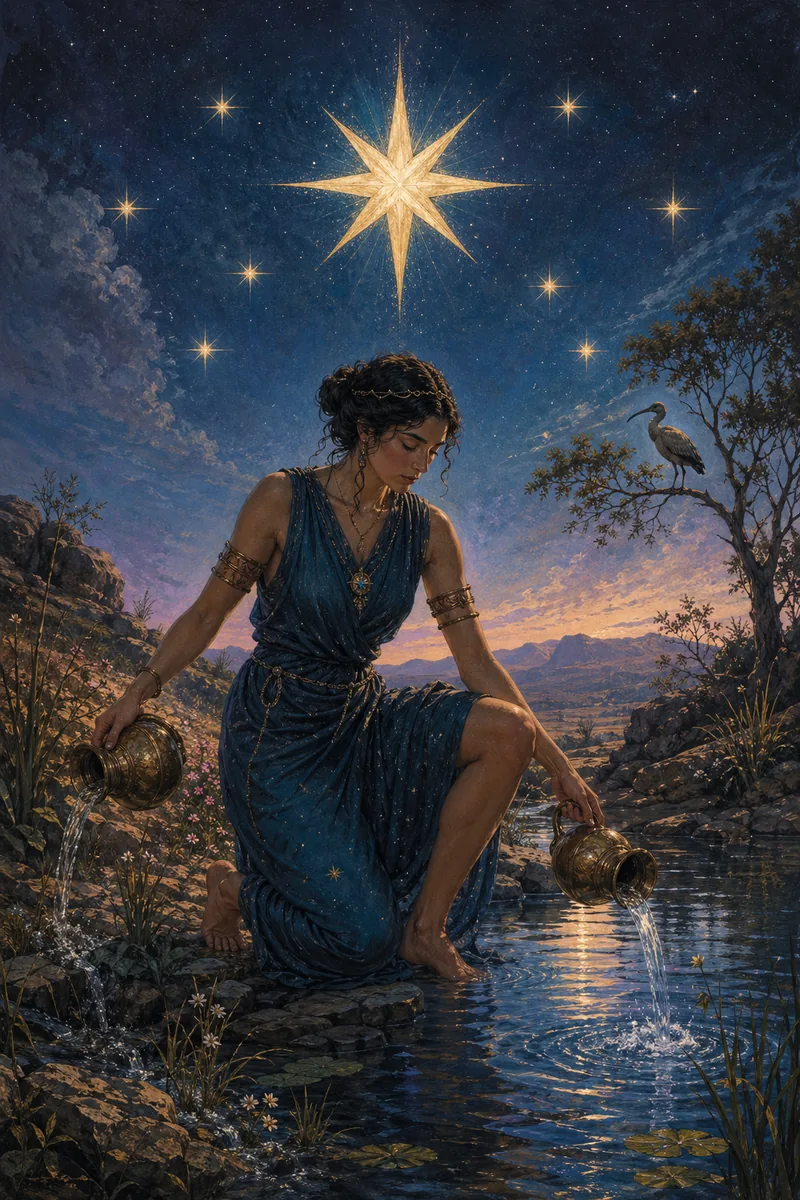
Major Arcana · 17
The Star
L'Étoile · Le Stelle · Stella
The The Star tarot card meaning runs through both orientations: upright, hope, renewal, inspiration; reversed, loss of faith, discouragement, disconnection from inspiration. Below, its imagery across the Rider–Waite–Smith, Thoth, and Marseille decks, and what the tradition’s writers said about it.
- Element
- Air
- Planet
- Uranus
- Zodiac
- Aquarius
- Hebrew
- Heh (or Tzaddi in Crowley's reformed assignment)
- Numerology
- 17
- Timing
- Aquarius season (January–February); within months; the night before dawn.
Upright
- hope
- renewal
- inspiration
- guidance
- spirituality
- serenity
Reversed
- loss of faith
- discouragement
- disconnection from inspiration
- creative drought
The Star Tarot Card Meaning
Upright
Hope returns. After the Tower's lightning, the sky clears and the Star appears. This is the card of regeneration — quiet, gentle, and unassuming. You are pouring yourself back into your life with renewed faith. The stream is flowing again. Don't rush; the Star is a slow card. Trust what is forming.
- Love
- Renewed hope after heartbreak. A relationship that feels like genuine soul connection — calm, healing, mutual. For singles, the readiness to love again. For couples, healing after a difficult chapter.
- Career
- Inspiration returns. A creative project that aligns with deeper purpose. Healing from career burnout. Roles in art, healing, astrology, teaching, science (Aquarius). Public recognition possible but not the point.
- Finances
- Slow, hopeful financial recovery. Money returning after a difficult phase. Generosity that returns multiplied. Conscious investment.
- Health
- Healing — gentle, slow, real. Recovery from illness or burnout. Reproductive health, hormonal balance returning. Detox. Hydration as ritual.
- Spiritual
- Direct connection with the divine. The mystical experience after the dark night. Astrology, sacred geometry, contemplative practice all favored. The wordless faith that survived the Tower.
Reversed
Loss of faith. The Star reversed is the dark sky with no orientation — the mystic without the mysticism, the artist without inspiration, the seeker who has stopped seeking. Often follows a Tower not yet integrated. Be patient; the Star returns.
- Love
- Discouragement in love. Hopelessness about partnership. Or, projecting impossible standards onto a real person. Both block the Star.
- Career
- Creative block. Loss of meaning in work. Burnout that hasn't healed. Disconnection from why you started.
- Finances
- Pessimism about money. Or refusing the small steps because the goal feels unreachable.
- Health
- Slow recovery feeling stalled. Hopelessness about chronic conditions. The body needs the patience the Star teaches.
- Spiritual
- Dark night that seems endless. Loss of practice. The teacher who disappointed. Reach out — the Star returns when you remember to look up.
Those are the card’s meanings in general. A reading tests them against the question the querent actually asked — the person asking is what makes one drawing of The Star differ from the next.
The image, three ways
Rider–Waite–Smith
A naked young woman kneels at the edge of a pool, pouring water from two pitchers — one onto the land, one into the water. Behind her, a great eight-pointed star shines in the sky surrounded by seven smaller stars. A bird (often an ibis) perches in a distant tree.
Thoth
A more mystical naked goddess pouring two streams; a great seven-pointed star of Babalon; cosmic spirals and waters. Crowley emphasizes the Star as the pure, illuminated soul after the Tower's destruction.
Marseille
L'Étoile — a naked woman kneeling, pouring water; one foot in water, one on land. Eight stars in the sky. Less elaborate, equally luminous.
Four ways a reversal speaks
After Mary K. Greer, Tarot Reversals (2002)
01 · blocked
Loss of hope; the well empty; the pitchers dry.
02 · denied
Healing refused; grace declined; the fresh start rejected as too good to be true.
03 · fading
Despair receding but slowly; the dark night thinning toward, not yet into, dawn.
04 · internalized
Hope held privately; the vow made in secret because it isn't yet survivable to say aloud.
What the tradition says
The tradition broadly agrees that the Star follows devastation with quiet restoration. Most readers understand the naked figure as the soul made vulnerable not by weakness but by readiness — stripped of armor, open to renewal. Pollack, Nichols, Greer, and Crowley all treat the card as a slow, generous refilling: hope that works by patience rather than force.
Where the readings differ: Waite lists loss and privation alongside hope as equally valid readings, preserving an older ambivalence the later tradition — Pollack, Nichols, Greer — largely sets aside in favor of unambiguous regeneration, while Crowley takes a distinct path, framing the card in cosmic and mythological terms rather than personal psychological recovery.
A.E. Waite · 1910
The Pictorial Key to the Tarot
Loss, theft, privation, abandonment; another reading: hope and bright prospects. Waite's contradictions reveal the card's ambivalence in older traditions.
Aleister Crowley · 1944
The Book of Thoth
The Star as Babalon — the divine feminine pouring her grace into the universe. The star above is the higher self; the water below, the lower; both fed by the same source.
Rachel Pollack · 1980
Seventy-Eight Degrees of Wisdom
The Star is the moment when the soul, having been stripped by the Tower, recognizes its own naked beauty and begins the gentle work of pouring itself back into life.
Sallie Nichols · 1980
Jung and Tarot: An Archetypal Journey
Nichols reads the Star as the resurrection of hope after the dark night — the soul's recognition that grace has not abandoned it, even after the Tower's catastrophe. The naked figure is the psyche unprotected because protection is no longer needed; the cosmos is found to be hospitable.
Mary K. Greer · 1984
Tarot for Your Self
Greer makes the Star concrete: ask the querent what wish they cannot quite admit they still have. The card is the permission to want what the Tower seemed to forbid wanting. Hope is not naive here — it is the slow, deliberate refilling of the well after a fire.
Shadow
The dreamer who never lands; the mystic who is too rarefied to act; toxic positivity that refuses to face shadow.
Archetypal role
The Lightbringer / Stella Maris (Star of the Sea) / The Hopeful One / The Guiding Light
Historical notes
The eight-pointed star is the star of Ishtar, of Venus, of regeneration in many ancient traditions. The card's water-bearer figure precedes the Aquarius association — Aquarius in Greco-Egyptian astrology was associated with the rising of the Nile, which marked the helical rising of Sirius. The Star is one of the most consistently positive cards across all traditions.
The Star: common questions
- Is The Star a yes or no card?
- In a yes-or-no reading, The Star leans yes.
- What do tarot writers agree The Star means?
- The tradition broadly agrees that the Star follows devastation with quiet restoration. Most readers understand the naked figure as the soul made vulnerable not by weakness but by readiness — stripped of armor, open to renewal. Pollack, Nichols, Greer, and Crowley all treat the card as a slow, generous refilling: hope that works by patience…
- What does The Star tarot card mean?
- Hope returns. After the Tower's lightning, the sky clears and the Star appears. This is the card of regeneration — quiet, gentle, and unassuming. You are pouring yourself back into your life with renewed faith. The stream is flowing again. Don't rush; the Star is a slow card. Trust what is forming.
- What does The Star mean in love?
- Renewed hope after heartbreak. A relationship that feels like genuine soul connection — calm, healing, mutual. For singles, the readiness to love again. For couples, healing after a difficult chapter.
- What does The Star mean for career and money?
- Inspiration returns. A creative project that aligns with deeper purpose. Healing from career burnout. Roles in art, healing, astrology, teaching, science (Aquarius). Public recognition possible but not the point.
- What does The Star reversed mean?
- Loss of faith. The Star reversed is the dark sky with no orientation — the mystic without the mysticism, the artist without inspiration, the seeker who has stopped seeking. Often follows a Tower not yet integrated. Be patient; the Star returns.
Neighbouring arcana
The Star combinations
Last reviewed 2026-06-18
Keep learning
Bring this card into a question
Begin a reading